

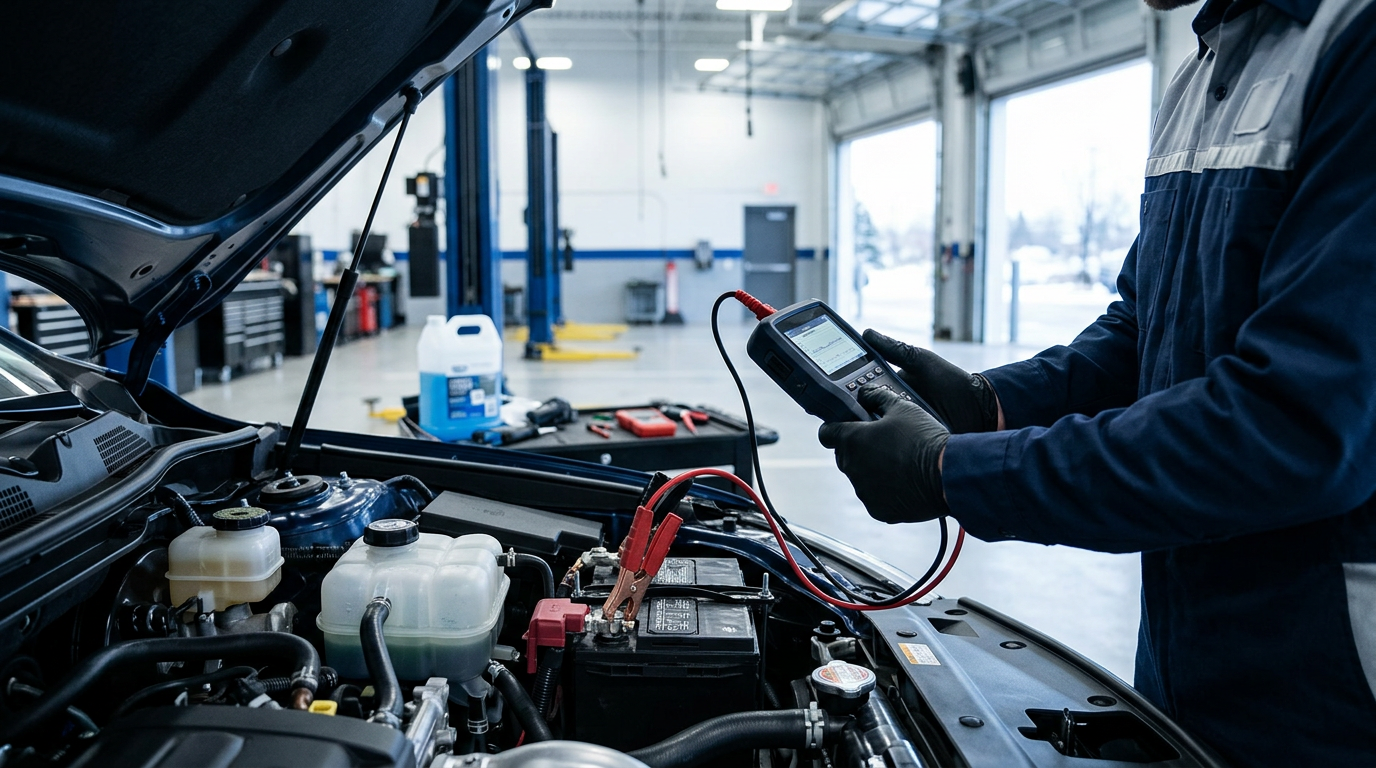
Preparing a Ford vehicle for winter weather requires inspecting critical systems that cold temperatures stress most, including the battery, engine coolant, tire tread and pressure, wiper blades, and braking components. Freezing temperatures reduce battery output, lower tire pressure by 1 to 2 PSI for every 10-degree drop, and increase engine load during cold starts. Routine winter prep involves verifying battery charge and Cold Cranking Amps, flushing or topping off engine coolant to the correct freeze-protection ratio, ensuring tire tread meets safety thresholds, and replacing worn wiper blades with winter-rated fluid.
Our factory-trained service team helps drivers stay ahead of seasonal hazards by performing comprehensive pre-winter vehicle inspections. If you need routine maintenance or a quick diagnostic check before freezing temperatures arrive, contact our team at (302) 734-0444 or stop by our service center on South Dupont Highway to ensure your vehicle is completely ready for cold-weather driving.
Table of Contents
- What Belongs on Your Essential Ford Winter Maintenance Checklist?
- How Does Cold Weather Affect Your Ford Battery and Cold Cranking Amps?
- Does Ford Intelligent AWD Require Special Winter Maintenance or Fluid Changes?
- What Are the Costs and Best Practices for Coolant Flushes and Remote Idling?
- Frequently Asked Questions About Winter Ford Maintenance
- Schedule Your Pre-Winter Ford Inspection at Winner Ford
What Belongs on Your Essential Ford Winter Maintenance Checklist?
An essential Ford winter maintenance checklist focuses on six vital areas: battery health, cooling system protection, tire condition, wiper and defroster function, brake performance, and driveline lubrication. Systematically inspecting each component prevents unexpected breakdowns during cold snaps and helps keep your family safe on slick morning roads.
Completing these routine checks ensures reliable performance throughout the coldest months of the year:
- Tire Tread and Inflation: Cold weather causes air to contract, reducing tire pressure by roughly 1 to 2 PSI for every 10-degree Fahrenheit drop in ambient temperature. According to National Highway Traffic Safety Administration winter driving guidance, tires must have at least 2/32 inch of tread depth to remain legal, though deeper tread provides superior traction in slush and snow. Always check tire pressure when tires are cold and inflate them to the recommended pressure listed on the Ford driver-door label—never the maximum pressure molded on the tire sidewall.
- Cooling System and Antifreeze: Engine coolant prevents freeze-ups inside the engine block and radiator core. Our technicians check coolant concentration using a refractometer to verify protection levels and inspect hoses for cracking or deterioration.
- Wiper Blades and Washer Fluid: Worn wiper blades leave streaks that compromise visibility in freezing rain or snow. Installing winter blades paired with de-icing washer fluid rated to at least -20 degrees Fahrenheit keeps glass clear. Operating washer systems with an empty reservoir can overheat the pump motor, so keeping fluid levels topped off is critical.
- Brake System Inspection: Slippery pavement requires balanced stopping power. A thorough brake check evaluates pad thickness, rotor surface condition, and brake fluid moisture levels. Modern Ford vehicles equipped with an advanced collision mitigation system and Anti-Lock Brakes (ABS) rely on firm, continuous pedal pressure during emergency stops on slick roads.
- Driveline and Battery Verification: Inspecting drive belts, alternator charging voltage, and driveline fluids ensures smooth power delivery when cold starts place maximum demand on the engine.
Commuters taking major highway routes through Smyrna frequently encounter rapidly changing road conditions during winter storms, making tire grip and clear visibility top priorities. Drivers navigating these daily routes count on vehicles like the 2026 Ford Explorer, which pairs a 2.3L engine with available Four-wheel drive and SelectShift® transmission to deliver confidence when road surfaces freeze. Scheduling seasonal service before winter settles in keeps every component operating at peak efficiency. When you are ready to prepare your vehicle for the season, consider scheduling a seasonal maintenance inspection or visiting our genuine Ford parts center for winter wiper blades and original equipment components.
How Does Cold Weather Affect Your Ford Battery and Cold Cranking Amps?
Cold weather significantly decreases chemical activity inside automotive batteries, reducing available starting power by up to 50 percent at freezing temperatures while gasoline and diesel engines simultaneously require higher cranking energy to start. Cold Cranking Amps (CCA) measure a battery's capability to deliver power at 0 degrees Fahrenheit for 30 seconds while maintaining functional voltage. When temperatures plummet, an aging battery with diminished CCA capacity struggles to turn over cold engine oil.
Most 12-volt car batteries have a functional lifespan of three to five years. During cold weather, weak batteries exhibit distinct warning signs, such as a slow engine crank during initial startup, dimming headlights at idle, or delayed power to interior accessories. Having our certified technicians perform a conductance test measures actual CCA output against the original Motorcraft® factory specification, identifying weak cells before they fail completely during a cold snap.
Electric and hybrid Ford vehicles also experience seasonal performance shifts during winter weather. Low ambient temperatures temporarily reduce high-voltage battery chemical efficiency, which can decrease total driving range. Pre-conditioning the cabin while connected to a charger uses grid power rather than battery energy, preserving driving range for your commute.
If a battery fails while traveling, Ford vehicle owners have access to manufacturer-backed emergency support. Emergency roadside assistance provides jump-starts, flat tire assistance, and towing to an authorized dealer service center. To request emergency towing or jump-start support, contact Ford Roadside Assistance at (800) 241-3673.
Does Ford Intelligent AWD Require Special Winter Maintenance or Fluid Changes?
Ford Intelligent AWD requires routine fluid inspections of the Power Transfer Unit (PTU) and rear differential assembly to protect internal gears against extreme heat and cold stress. Unlike conventional four-wheel-drive systems that require manual engagement, Intelligent AWD uses electronic sensors to monitor wheel speed, throttle position, and steering angle, instantly shifting torque to the wheels with the most grip. Maintaining clean, high-grade synthetic gear lubricants ensures these electro-mechanical actuators respond instantly on icy surfaces.
The driveline maintenance steps below keep all-wheel-drive and four-wheel-drive systems operating smoothly in cold conditions:
- Inspect Power Transfer Unit (PTU) Fluid: Check the fluid level and condition inside the PTU to prevent thermal degradation and fluid breakdown during heavy torque transfers.
- Verify Rear Differential Lubricant: Inspect the rear drive unit fluid for water contamination or metal wear particles that reduce lubricating effectiveness in freezing weather.
- Check CV Axle Boots and Seals: Examine rubber constant-velocity boots for cracks or tears that permit road salt and water to enter precision joint assemblies.
- Calibrate Selectable Drive Modes: Test the vehicle's drive mode selector to confirm seamless engagement of Slippery mode or Deep Snow/Sand mode, which adjusts throttle sensitivity and traction control interventions.
Drivers negotiating the gently rolling hills and wooded back routes around Middletown depend heavily on responsive driveline systems when shaded pavement turns to black ice. Models like the 2026 Ford F-150 equipped with a 3.5L engine and Four-wheel drive deliver impressive control when driveline fluids are maintained according to factory service intervals. Inspecting transfer case and differential fluids prior to severe winter weather protects heavy-duty components against accelerated wear.
What Are the Costs and Best Practices for Coolant Flushes and Remote Idling?
A standard Ford engine coolant flush removes accumulated rust scale and sediment while replenishing essential corrosion inhibitors, ensuring the engine block remains protected against internal freezing down to target winter temperatures. Engine coolant consists of a 50/50 mixture of concentrated antifreeze and distilled water. Over years of thermal heating cycles, chemical additives break down, increasing the risk of internal radiator corrosion, heater core blockages, and water pump seal failure. Replacing old coolant according to factory intervals maintains proper thermal management and protects cabin heater efficiency.
Remote idling is a popular winter feature, but extended idling is inefficient and unnecessary for modern fuel-injected engines. Today's Ford engines build full oil pressure within 30 to 60 seconds after startup. Idling an engine for extended periods burns between 0.2 and about 0.5 gallons of fuel per hour while generating minimal warmth for driveline components like the transmission and wheel bearings, which only warm up when the vehicle is in motion.
Best practices for winter engine warmup include:
- Limit Remote Start Time: Limit remote idling to 5 or 10 minutes to clear windshield frost and pre-warm the cabin while conserving fuel.
- Drive Gently Initially: Accelerate smoothly for the first few miles of driving to bring the engine, transmission, and differential fluids up to normal operating temperatures evenly.
- Utilize Heated Features: Rely on heated seats and heated steering wheels for immediate personal comfort rather than waiting for engine coolant to heat the entire cabin volume.
Following these practical steps reduces engine wear, saves fuel, and maintains peak heating performance throughout the winter months.
Frequently Asked Questions About Winter Ford Maintenance
Q: How often should tire pressure be checked during cold Mid-Atlantic winter months?
Tire pressure should be checked at least once a month and prior to extended highway trips during winter. Because air pressure drops roughly 1 to 2 PSI for every 10-degree drop in ambient temperature, sudden cold snaps can cause tires to become underinflated rapidly. Always measure inflation when tires are cold and set them to the recommended pressure indicated on the vehicle's driver-door jamb sticker.
Q: What freeze protection rating is recommended for washer fluid in local winter driving?
Windshield washer fluid rated to at least -20 degrees Fahrenheit is recommended for regional winter driving. Standard summer formulas contain higher water concentrations that freeze upon contact with a cold windshield or inside the washer fluid lines and reservoir tank. Using winter-specific fluid containing de-icing agents prevents reservoir cracking and maintains clear driver visibility during snowstorms.
Q: Should wiper blades be lifted off the windshield overnight during a snowstorm?
Lifting wiper arms off the windshield prevents rubber blades from freezing directly to the glass surface, protecting the rubber edge from tearing when turned on. However, high winds can snap elevated wiper arms back down against the glass, potentially cracking the windshield. Using a protective windshield cover or ensuring wipers are completely switched off before turning off the ignition protects wiper motor gears from overload damage upon engine startup.
Q: What is included when technicians perform a pre-winter multi-point inspection?
A pre-winter multi-point inspection evaluates battery Cold Cranking Amps, charging system output, engine coolant concentration and hose integrity, tire tread depth and inflation pattern, brake pad and rotor wear, steering linkage, drive belt tension, exterior lighting, wiper blade condition, and heating system operation. Catching minor wear issues during an autumn inspection prevents cold-weather breakdowns.
Q: What winter checks should be prioritized for Ford diesel engines or electric vehicles?
Ford PowerStroke® diesel models require checking glow plug operation, verifying fuel heater function, and adding anti-gel fuel additives during extreme cold to prevent paraffin wax formation in fuel filters. Electric vehicles like the Mustang Mach-E® benefit from thermal battery preconditioning while plugged into Level 2 chargers, verifying tire pressure for range efficiency, and maintaining clear sensor lenses for driver-assist systems.
Schedule Your Pre-Winter Ford Inspection at Winner Ford
Seasonal winter maintenance protects your investment, preserves long-term vehicle reliability, and helps keep your family safe during challenging driving conditions. Taking a proactive approach to battery health, tire grip, brake condition, and engine cooling systems ensures your vehicle performs dependably on every daily commute or weekend trip.
Our factory-certified technicians use genuine original equipment parts and diagnostic equipment designed specifically for your vehicle. Whether you drive a truck, an SUV, or a hybrid model, our team provides expert care tailored to your driving habits. To prepare your vehicle for freezing temperatures, call our service team at (302) 734-0444 or stop by our Dover service facility on South Dupont Highway to schedule your winter service appointment today.