
Preparing a Ford SUV for a long highway road trip requires verifying key mechanical systems 1 to 2 weeks prior to departure. A proper pre-trip preparation includes inspecting engine oil and coolant levels, testing battery charge health, verifying tire inflation pressures and tread depth, inspecting brake system components, and checking wiper blades and washer fluid. Ensuring these critical maintenance items are addressed helps maintain highway efficiency and prevents unexpected breakdowns during holiday travel.
Long-distance highway driving puts sustained stress on your vehicle's engine, cooling loop, braking hardware, and tires. While modern Ford crossovers and SUVs are built for durability, long stretches of high-speed travel accelerate heat buildup in essential fluids and expose hidden mechanical vulnerabilities. Drivers heading out on extended journeys from Middletown often encounter shifting weather conditions and dense highway traffic along major Mid-Atlantic transit corridors. Addressing proactive maintenance measures well before loading up luggage ensures your vehicle delivers efficient operation, predictable stopping power, and added confidence.
A comprehensive pre-trip strategy focuses on three core pillars: fluid health, tire integrity, and electrical reliability. Engine oil lubricates critical internal components under sustained high RPMs, while engine coolant regulates temperatures during prolonged highway cruising. Tires require precise inflation pressure adjustments to match vehicle load weights and protect against uneven tread wear or thermal blowout risks. Finally, modern Ford SUVs rely heavily on stable battery voltage to power advanced driver-assist systems and onboard infotainment features.
Our certified service facility is conveniently situated to serve regional drivers. If you need expert guidance before setting out on your trip, contact our team at (302) 734-0444 or stop by our Dover service location for professional support.
Table of Contents
- What Essential Maintenance Items Should Be Checked Before Holiday Travel?
- Which Ford SUV Driver Assistance Features Best Reduce Highway Fatigue?
- How Does Ford Intelligent AWD and Drive Modes Handle Snow and Ice on Long Trips?
- Does Ford Protect Roadside Assistance Cover Towing and What Emergency Gear Should You Pack?
- Common Questions About Pre-Trip Ford SUV Maintenance
- Schedule Your Pre-Trip SUV Inspection at Winner Ford
What Essential Maintenance Items Should Be Checked Before Holiday Travel?
A thorough pre-trip maintenance check requires inspecting six vital vehicle areas: engine oil, cooling system fluid, braking components, tire condition, battery health, and visibility equipment. Inspecting these core components ensures your vehicle remains reliable, efficient, and safe across hundreds of highway miles.
| Maintenance Component | Pre-Trip Inspection Focus | Recommended Action Threshold |
|---|---|---|
| Engine Oil | Level, color, and monitor status | Replace if under 20% oil life |
| Cooling System | Coolant level and hose integrity | Top off with OEM approved coolant |
| Braking System | Pad thickness and rotor condition | Replace pads measuring under 3mm |
| Tires | PSI rating and tread depth | Set PSI to door-jamb specification |
| Battery & Electrical | Voltage output and terminal corrosion | Test battery if older than 3 years |
| Wiper Blades & Washer | Blade wear and reservoir fluid | Install fresh all-weather blades |
Engine oil plays a primary role in protecting internal components during high-speed highway travel. If your vehicle's Intelligent Oil-Life Monitor shows less than 20 percent oil life remaining, scheduling an oil and filter change before your trip prevents breakdown of essential lubricants mid-journey. Cooling systems must also be checked for proper coolant mixture levels and hose elasticity to guard against engine overheating in heavy highway traffic.
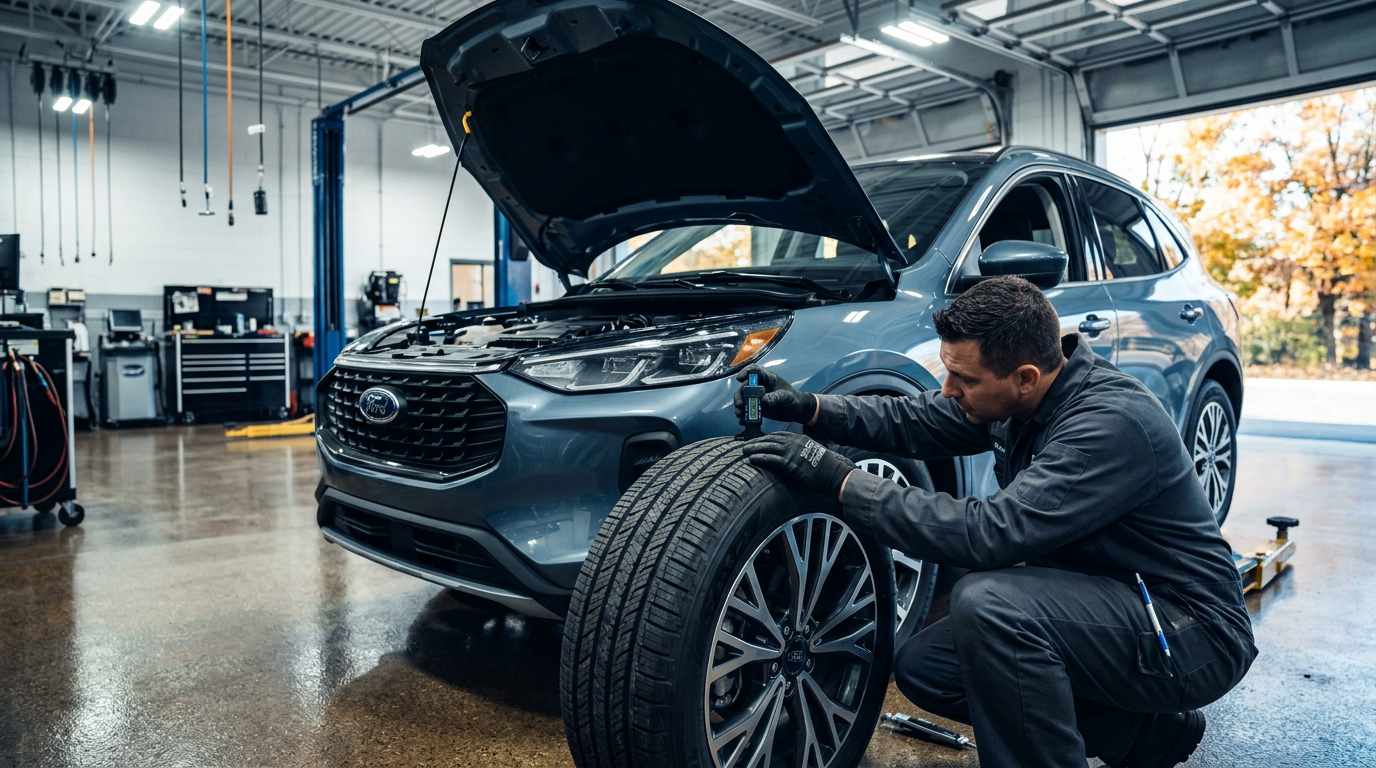
Tire safety is equally essential for long-distance travel. Inspect tread depth using a digital gauge to ensure adequate wet-weather grip, and set cold inflation pressures strictly to the specifications listed on your vehicle's driver-side door jamb. Underinflated tires generate excess heat at highway speeds, reducing fuel efficiency and increasing the risk of tread separation. Brakes should be evaluated for pad thickness and rotor smoothness to ensure rapid, linear stopping performance when fully loaded with passengers and cargo.
Our service advisors usually recommend booking a pre-trip check 1 to 2 weeks before heading out for the holidays, which leaves plenty of time to address brake wear or battery issues without any last-minute stress. You can conveniently prepare your SUV by scheduling a pre-trip inspection online. Our certified technicians use factory-approved replacement parts directly from our genuine Ford parts department to keep your vehicle performing at factory standards.
Which Ford SUV Driver Assistance Features Best Reduce Highway Fatigue?
Ford driver assistance technologies reduce long-distance driving fatigue by automating speed control, steering adjustments, and lane positioning on eligible highways. Features like Adaptive Cruise Control, Lane-Centering Assist, and available Ford BlueCruise hands-free driving significantly lighten driver workload during extended road trips.
Sustained highway travel requires constant physical adjustments and mental focus. Ford Co-Pilot360® packages advanced safety features that actively assist the driver:
- Adaptive Cruise Control with Stop-and-Go: Automatically maintains a preset distance from the vehicle ahead, adjusting speed down to a complete stop in congestion and resuming set speeds when traffic clears.
- Lane-Centering Assist: Uses forward-facing cameras to detect lane markings, providing continuous steering support to keep the vehicle centered within its lane.
- Speed Sign Recognition: Monitors posted speed limits and can automatically adjust cruise settings to match legal speed changes along highway routes.
- In-Lane Repositioning: Subtly shifts your SUV away from oversized vehicles in adjacent lanes, providing extra lateral clearance when passing semi-trucks.
- Lane Change Assist: Executes controlled lane changes on hands-free highways when the driver activates the turn signal switch, provided the adjacent lane is clear.
For ultimate long-distance comfort, available Ford BlueCruise offers true hands-free highway driving on over 130,000 miles of pre-mapped divided highways designated as Blue Zones across North America. The system uses an infrared driver-facing camera to track eye gaze and head position, ensuring the driver remains attentive to the road ahead while the vehicle manages steering, acceleration, and braking.
Driver assistance features are widely available across our SUV lineup. For example, the 2026 Ford Explorer features standard Ford Co-Pilot360® Assist+ technology and offers standard 6-passenger seating with 16 cubic feet of rear cargo space, making it a capable long-distance highway vehicle for growing families.
How Does Ford Intelligent AWD and Drive Modes Handle Snow and Ice on Long Trips?
Ford Intelligent AWD automatically continuously monitors traction conditions and seamlessly redistributes torque between front and rear wheels to maintain stability on snowy or icy highways. Unlike traditional four-wheel-drive systems, Intelligent AWD operates without driver intervention and automatically disconnects the rear driveline when traction is secure to optimize fuel economy.
On long holiday trips where winter weather can develop unexpectedly, drivetrain intelligence makes a measurable difference in control and efficiency. Traditional 4WD systems use a manual transfer case that locks front and rear axles at fixed 50/50 torque splits. While effective for heavy off-road crawling, mechanical 4WD causes drivetrain binding on dry highway pavement and requires manual engagement when conditions change.
Ford Intelligent AWD continuously evaluates throttle position, wheel speed, and steering angle hundreds of times per second. When driving along flat suburban roads in Smyrna during winter, the system delivers power efficiently while remaining ready to engage rear-wheel torque instantly if patches of black ice or slush are detected.
To further enhance winter capability, Ford SUVs equipped with the Terrain Management System™ offer selectable drive modes specifically calibrated for frozen roads:
- Slippery Mode: Adjusts throttle response to prevent wheel spin, optimizes transmission shift points, and increases traction control sensitivity on icy or wet pavement.
- Deep Snow/Sand Mode: Tailors engine output and allows controlled wheel slip to build momentum through packed snow drift accumulation.
- Normal Mode: Prioritizes balanced handling and maximizes fuel economy during dry highway conditions by decoupling rear-drive components when AWD is unnecessary.
Compact options like the 2026 Ford Escape feature available Intelligent AWD paired with an efficient 1.5L EcoBoost® engine paired with an 8-speed automatic transmission, delivering competitive EPA-estimated fuel economy while delivering robust winter traction.
Does Ford Protect Roadside Assistance Cover Towing and What Emergency Gear Should You Pack?
Ford Protect Roadside Assistance includes complimentary 24/7 towing coverage across all 50 U.S. states and Canada to the nearest authorized Ford dealership during warranty periods and active coverage plans. The program provides comprehensive emergency assistance including flat tire changes, battery jump-starts, fuel delivery, and lockout services to keep your journey moving smoothly.
Having manufacturer-backed coverage ensures that if an unexpected mechanical issue occurs out of state, your vehicle is transported directly to factory-trained technicians who use genuine OEM parts. If you experience a roadside emergency during your travel, you can reach immediate assistance directly through Ford Roadside Assistance at (800) 241-3673.
In addition to manufacturer roadside coverage, packing a dedicated highway emergency kit inside your SUV provides crucial safety protection while waiting for roadside support. Essential emergency roadside items include:
- Portable lithium battery jump starter pack or heavy-duty jumper cables
- Compact 12-volt air compressor and digital tire pressure gauge
- LED flashlight with extra batteries or USB rechargeable power bank
- Reflective warning triangles or LED emergency road flares
- Complete automotive first-aid kit with sterile bandages and antiseptic wipes
- Heavy thermal blankets, emergency water bottles, and non-perishable snacks
Common Questions About Pre-Trip Ford SUV Maintenance
How far in advance of a road trip should pre-trip maintenance be scheduled?
Q: How far in advance of a road trip should pre-trip maintenance be scheduled?
Scheduling pre-trip service 1 to 2 weeks prior to your departure date provides adequate time to perform a multi-point inspection and resolve any identified mechanical repairs without rushing. Booking service early ensures necessary replacement parts can be sourced and installed, preventing last-minute travel delays.
How much does a dealer multi-point pre-trip inspection cost for a Ford SUV?
Q: How much does a dealer multi-point pre-trip inspection cost for a Ford SUV?
A standalone multi-point pre-trip inspection pricing may vary at certified Ford dealerships. However, this comprehensive check may be included with certain routine maintenance packages, depending on current dealership offerings.
Should engine oil be changed right before a long highway road trip?
Q: Should engine oil be changed right before a long highway road trip?
Engine oil should be changed before a long trip if your vehicle's Intelligent Oil-Life Monitor shows less than 20 percent remaining life or if your planned travel mileage will exceed your upcoming service interval. Fresh motor oil ensures maximum engine thermal protection during sustained highway speeds.
What maintenance schedule should be followed before a long highway trip in a 2027 Ford SUV?
Q: What maintenance schedule should be followed before a long highway trip in a 2027 Ford SUV?
Owners should follow the maintenance schedule specified in their vehicle's owner manual, checking fluid levels, tire condition, and brake wear before setting out. Any routine maintenance items due within 1,000 miles of your planned travel distance should be completed prior to departure.
Does Ford Protect Roadside Assistance cover rental vehicle reimbursement during unexpected roadside breakdowns?
Q: Does Ford Protect Roadside Assistance cover rental vehicle reimbursement during unexpected roadside breakdowns?
Ford Protect extended service plans frequently include trip interruption coverage and rental vehicle reimbursement options when mechanical repairs require an overnight stay far from home. Specific coverage terms depend on your active plan tier, so checking plan details prior to traveling is recommended.
Schedule Your Pre-Trip SUV Inspection at Winner Ford
Taking time to prepare your Ford SUV before holiday highway travel ensures reliable vehicle performance, protects passenger safety, and prevents unexpected travel delays. From checking vital fluid levels and tire pressures to confirming battery health and driver-assist calibration, thorough maintenance allows you to drive confidently on every leg of your journey.
Our factory-trained technicians at Winner Ford are ready to inspect your crossover or SUV and perform all necessary maintenance using genuine factory parts. Visit us at our Dover service facility or speak directly with our service team by calling (302) 734-0444 to schedule your pre-trip service appointment today.