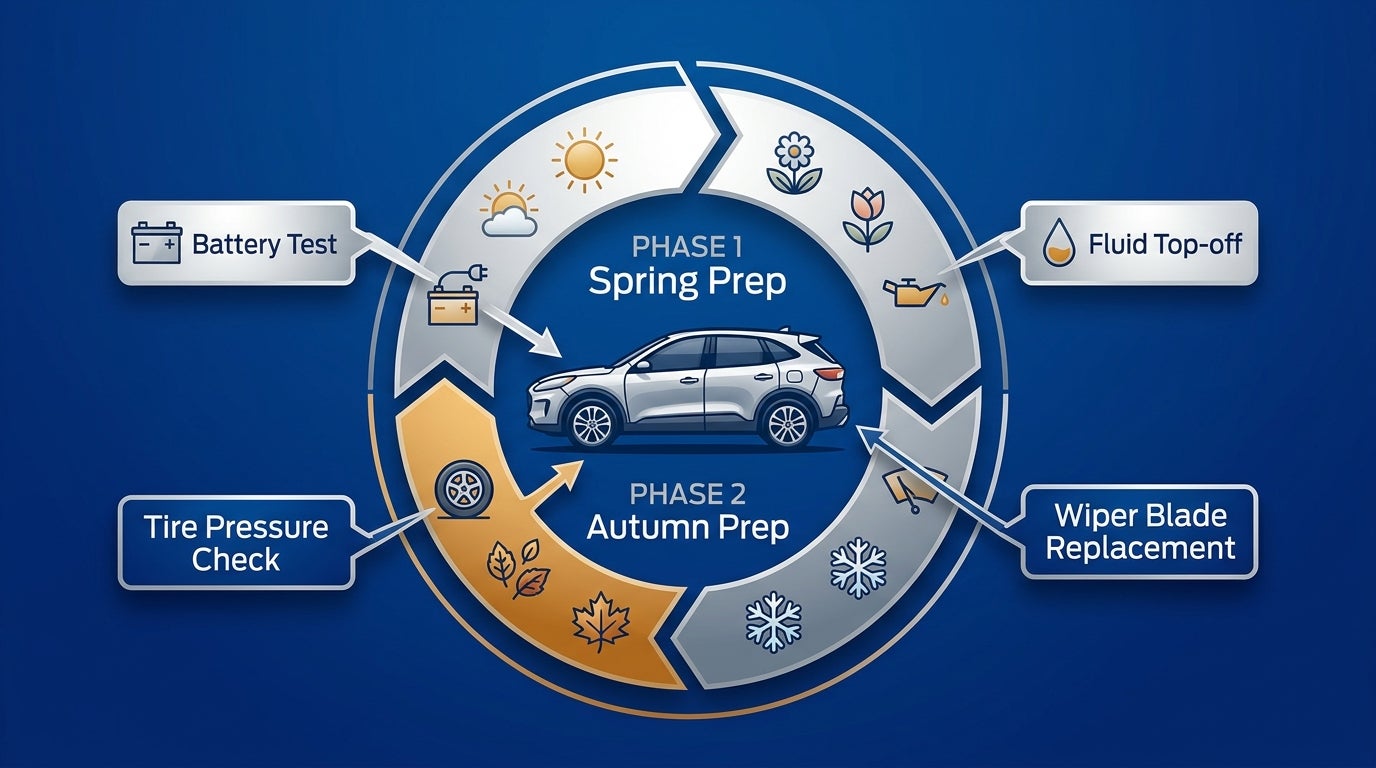

Ford owners should schedule seasonal maintenance twice a year or every 7,500 to 10,000 miles, ideally in spring and autumn before extreme weather arrives. This timing aligns with standard oil change intervals and allows technicians to address fluid degradation, battery stress, and tire pressure shifts before winter cold or summer heat strains your engine. Booking service twice annually prevents minor environmental wear from developing into costly mechanical repairs. Seasonal maintenance centers on protecting mechanical and electrical components against localized weather demands. Mid-Atlantic temperature swings alter tire pressure by roughly 1 PSI for every 10-degree change in ambient air, while humidity and road grime degrade rubber wiper blades and clog air filtration systems. Drivers navigating the tidal roads and coastal air around Milford benefit from timing these visits every six months, as atmospheric salt and high moisture accelerate undercarriage oxidation and breakdown of exposed rubber seals. Ford equips modern vehicles with the onboard Intelligent Oil-Life Monitor, which continuously tracks engine temperatures, total load, idling hours, and ambient conditions to signal when service is required. Operating under severe conditions—such as frequent towing, commercial hauling, or extended idling—breaks down oil viscosity faster and shortens your maintenance window to roughly 3,000 to 5,000 miles. Following these dynamic notifications helps preserve factory warranty coverage while maintaining long-term engine performance. To maintain continuous vehicle health, plan your appointment ahead of peak seasonal transitions in early spring and early autumn. Pre-booking service ensures you secure a convenient time slot before weather shifts create high shop demand. You can reach our advisors at (302) 734-0444 or drop by our Dover service center address at 591 S Dupont Hwy for personalized maintenance guidance. Table of Contents Why Is Summer Maintenance Essential and Which Motor Oil Does Ford Recommend? Does The Works Service Package Include Fluid Top-Offs and What Services Pair Best with It? What Is Included in a Comprehensive Ford Brake Inspection? What Seasonal Ford Checks Can You Perform at Home Before Visiting the Dealer? How Can Dover Ford Owners Schedule a Seasonal Service Appointment Online? Common Questions About Ford Seasonal Service Protect Your Ford with Expert Seasonal Care at Winner Ford Why Is Summer Maintenance Essential and Which Motor Oil Does Ford Recommend? Summer maintenance is vital because extreme heat accelerates battery fluid evaporation, thins engine oil, and increases cooling system pressure under heavy air conditioning loads. High ambient temperatures degrade protective oil additives faster than winter driving, making a fresh lubricant oil service critical before warm-weather road trips. For optimal seasonal protection, Ford recommends Motorcraft synthetic blend or full synthetic oil specifications, such as Motorcraft SAE 5W-20 or Motorcraft SAE 5W-30, which meet rigorous Ford engineering standards WSS-M2C960-A1 or WSS-M2C961-A1. Using factory-certified motor oil ensures proper viscosity across fluctuating engine temperatures. Modern engines rely on tight tolerances and precise hydraulic pressure for variable camshaft timing. Full synthetic formulations maintain stable film strength at elevated summer operating temperatures while providing rapid circulation during cold morning starts. When servicing models like a 2026 Ford Escape Active featuring the 1.5L engine or a 2026 Ford Explorer XLT equipped with the 2.3L EcoBoost, using the precise Motorcraft oil viscosity protects turbocharger bearings and internal seals against thermal breakdown. Heat also places severe demands on your vehicle’s electrical architecture and cooling loop. High under-hood temperatures accelerate internal battery plate corrosion, often causing an aging 12-volt battery to fail unexpectedly when running cabin cooling systems at high output. Summer service includes checking coolant hydrometer levels to maintain a proper 50/50 mixture of Motorcraft Yellow Antifreeze and distilled water, preventing boil-overs and scale buildup within the radiator block. When preparing your truck or SUV for warm-weather driving, you can easily schedule your seasonal service online to ensure your cooling system and engine oil meet factory specifications. If you prefer replacing engine or cabin air filters at home using original equipment, our specialized parts center supplies genuine Motorcraft components engineered specifically for your Ford vehicle. Does The Works Service Package Include Fluid Top-Offs and What Services Pair Best with It? Yes, The Works service package includes essential fluid top-offs as a core component of its multi-point inspection. Certified technicians inspect and replenish vital vehicle fluids, including windshield washer fluid, power steering fluid, engine coolant, and transmission fluid, to ensure proper operating levels. This comprehensive maintenance bundle also combines a synthetic blend oil change, oil filter replacement, tire rotation, pressure adjustment, and a detailed brake inspection into a single visit. Combining routine service procedures during The Works provides thorough preventative care while saving time in the service drive. Pairing an oil change with a tire rotation every 7,500 to 10,000 miles ensures even tread wear across all four positions, extending overall tire life and preserving all-wheel-drive performance on vehicles like the 2026 Ford F-150 XLT featuring the 3.5L EcoBoost engine. Rotating tires regularly helps maintain balanced traction and predictable handling during sudden rain showers. In addition to fluid management and tire rotations, seasonal maintenance offers the ideal opportunity to address secondary wear items that impact cabin comfort and engine efficiency: Cabin Air Filter Replacement: Swapping the cabin air filter every 15,000 to 20,000 miles clears accumulated pollen, dust, and debris, preserving HVAC blower motor longevity and airflow. Engine Air Filter Service: Replacing the engine air intake filter every 30,000 miles ensures clean air delivery to the combustion chambers, protecting fuel economy and throttle response. Battery Load Testing: Performing a digital conductance test measures cold-cranking capacity, identifying battery degradation before a no-start condition occurs. Wiper Blade Inspection: Replacing streaking or chattered wiper blades every six months guarantees clear forward visibility through heavy seasonal downpours. When drivers inquire about seasonal maintenance during a routine visit, our service team recommends completing these combined checks to establish a documented service history. Catching minor fluid loss or uneven tire wear early prevents unexpected downtime and keeps your vehicle running reliably throughout the year. What Is Included in a Comprehensive Ford Brake Inspection? A comprehensive Ford brake inspection evaluates the entire friction and hydraulic assembly, including brake pad thickness, rotor surface condition, caliper operation, slider pin movement, and hydraulic fluid moisture content. Technicians measure inner and outer friction material against minimum safety thresholds, inspecting rotors for heat cracking, scoring, or excessive thickness variation that causes pedal pulsation. Inspecting hydraulic lines and brake fluid condition is equally essential for stopping performance. Hydraulic brake fluid is hygroscopic, meaning it naturally absorbs ambient moisture over time. Accumulated moisture lowers the fluid's boiling point, which can create pedal sponginess and internal corrosion within caliper pistons and anti-lock braking system valves. Ford recommends flushing and replacing hydraulic brake fluid every three years regardless of mileage to preserve crisp pedal feel and rapid ABS response. Regular brake checks are especially important for high-capacity SUVs and trucks that manage heavy passenger loads or frequent trailering. Components on a 2026 Ford F-150 XLT rated for up to 10,400 lbs of towing capacity experience significant thermal stress during braking cycles. Catching worn friction pads or sticking slider pins early protects expensive brake rotors from damage, ensuring your stopping system performs reliably under heavy load conditions. What Seasonal Ford Checks Can You Perform at Home Before Visiting the Dealer? Vehicle owners can perform several straightforward maintenance checks at home between scheduled service appointments using basic tools. Performing visual inspections once a month helps identify developing maintenance needs early, ensuring your vehicle remains safe and efficient between professional service visits. Key DIY seasonal maintenance checks include: Cold Tire Pressure Inspection: Use a reliable digital tire gauge to check inflation levels when tires have been parked for at least three hours. Compare readings against the recommended PSI printed on the driver-side doorjamb placard, rather than the maximum pressure listed on the tire sidewall. Tread Depth Verification: Inspect tire tread depth across the entire width of each tire using a tread depth gauge or the penny test. Tread depth measuring at or below 2/32 of an inch indicates immediate replacement is necessary to prevent hydroplaning on wet surfaces. Fluid Level Monitoring: Park on a level surface, pop the hood, and visually check transparent reservoir levels for engine coolant, windshield washer fluid, and power steering fluid. Top off low washer fluid using seasonal formulas designed to clear bugs in summer or resist freezing in winter. Wiper Blade & Light Checks: Inspect rubber wiper edges for tearing or splitting, replacing blades that leave streaks. Have a family member stand behind the vehicle while you verify that headlights, high beams, brake lights, and turn signals function correctly. While visual inspections are easy to manage at home, complex procedures belong in a professional service bay. Hydraulic fluid flushes, air conditioning pressure diagnostics, and 12-volt battery replacements on modern Ford models require resetting the onboard Battery Management System using factory diagnostic tools to ensure correct charging behavior. How Can Dover Ford Owners Schedule a Seasonal Service Appointment Online? Ford owners can schedule a seasonal service appointment online in minutes through our dealer portal or the Ford App by selecting their specific year, model, mileage interval, and required service procedures. The digital scheduling platform allows you to choose your preferred advisor, select available calendar dates, and pick appointment times that fit your daily schedule without making a phone call. Suburban commuters traveling along Route 1 from Smyrna appreciate the convenience of managing maintenance digitally, reserving drop-off windows that align with work travel. Online scheduling provides clear service visibility, allowing you to select The Works package, request a comprehensive multi-point inspection, or note specific performance observations directly within your booking profile. If you encounter unexpected roadside issues like a flat tire or battery failure while traveling, Ford Roadside Assistance provides manufacturer-backed emergency support. Assistance can be requested through the Ford App or by calling Ford Roadside Assistance: 1-800-241-3673 for towing to authorized service centers, battery jump-starts, and fuel delivery backed by factory warranty coverage. For personalized assistance or specific vehicle diagnostic inquiries, our service team remains available to guide your maintenance planning. You can call our team directly at (302) 734-0444 or view directions to our Dover service center to visit our facility at 591 S Dupont Hwy for in-person support. Common Questions About Ford Seasonal Service Q: What causes tire pressure warnings to illuminate when weather turns cold? A: Ambient temperature drops cause air molecules inside your tires to contract, reducing internal inflation pressure by approximately 1 PSI for every 10-degree drop in outdoor air. This natural drop triggers the tire pressure monitoring system indicator on chilly mornings, requiring drivers to inflate tires back to the doorjamb placard specification. Q: How often does Ford recommend replacing cabin and engine air filters? A: Ford recommends replacing the cabin air filter every 15,000 to 20,000 miles and the engine air intake filter every 30,000 miles under normal driving conditions. Driving in high-pollen areas, dusty unpaved roads, or heavy traffic environments may require annual replacement to maintain optimal airflow and interior air quality. Q: Why is a battery load test recommended before seasonal heat or cold waves? A: Temperature extremes place heavy electrical demands on 12-volt vehicle batteries while accelerating internal degradation. A digital load test measures cold-cranking capacity and internal resistance, identifying plate sulfation or electrolyte loss early so you can replace an aging battery before experiencing a sudden no-start event. Q: How long can you drive when the Intelligent Oil-Life Monitor displays a service prompt? A: When the Intelligent Oil-Life Monitor displays an oil service message, you should schedule maintenance within 500 miles or two weeks. Continuing to drive past the service notification risks thermal breakdown of oil additives, increasing friction wear on internal engine components and turbocharger bearings. Q: What should you do if your engine coolant reservoir level is below the fill line? A: If the coolant level drops below the minimum fill line on a cold engine, top it off using a 50/50 prediluted mixture of Motorcraft Yellow Antifreeze and distilled water. Avoid using plain tap water, as mineral deposits create internal radiator scale and reduce overall cooling efficiency. Protect Your Ford with Expert Seasonal Care at Winner Ford Maintaining a regular seasonal maintenance schedule protects your powertrain investment, preserves daily fuel efficiency, and keeps your vehicle performing safely through changing weather. Following factory service guidelines prevents unexpected component wear, ensuring your truck or SUV remains reliable mile after mile. Our certified technicians at Winner Ford provide expert care tailored specifically to your vehicle. Utilizing factory diagnostic tools and genuine Motorcraft parts, our team delivers complete maintenance procedures engineered to original specification standards. When you are ready to prepare your vehicle for upcoming seasonal travel, rely on our team for convenient service scheduling and trusted technical advice. Visit our Dover location at 591 S Dupont Hwy or book your next maintenance appointment online to keep your Ford running at its absolute best. © 2026 Winner Ford. All rights reserved. Vehicle specification data © JATO Dynamics Limited.