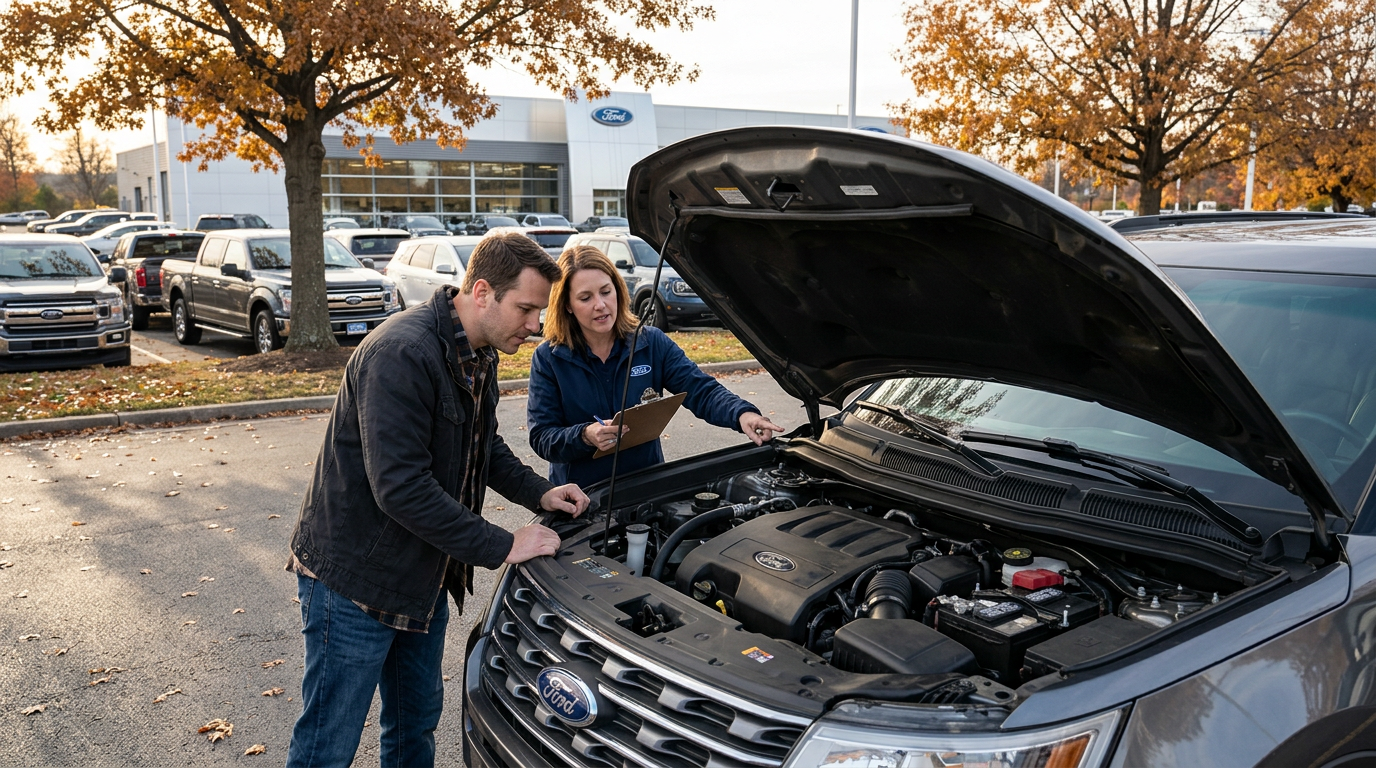

To thoroughly inspect under the hood of a used car, check the engine oil, coolant level and color, brake and power steering fluids, battery terminals, serpentine belts, radiator hoses, and visible gaskets for active leaks or dark sludge. Look closely at the oil cap for milky residue, inspect hose rubber for swelling or cracks, and check for frame damage or fresh fluid drips beneath the engine bay. Inspection Component Key Warning Signs to Watch For Engine Oil & Filler Cap Low oil level, dark sludge, or milky residue Cooling System & Reservoir Rust-colored fluid, low coolant, or bulging hoses Battery & Electrical Terminals White or green corrosion, loose cables, cracks Drive Belts & Hoses Fraying, rib cracks, squealing, or soft rubber Engine Bay & Undercarriage Active drips, burning fluid smell, body filler Popping the hood provides an immediate window into how well a previous owner maintained the vehicle. Engine components should look weathered from normal driving, but excessive oil grime baked onto the cylinder heads or exhaust manifold points to unaddressed valve cover or head gasket leaks. A spotless, freshly steam-cleaned engine bay can sometimes conceal recent leaks, making a test drive and secondary post-drive visual review essential. Drivers commuting daily near the St. Jones River corridor put consistent mileage on their powertrains, making detailed mechanical inspections critical for overall vehicle longevity. When examining a pre-owned truck or crossover, check the inner fender wells, strut towers, and front crossmembers for severe rust or frame pull marks that suggest prior structural repairs. Connecting a handheld OBD-II scanner to the diagnostic port under the dash reveals whether computer readiness monitors are complete or if trouble codes were recently cleared. Our team at Winner Ford conducts rigorous multi-point mechanical inspections on every pre-owned model entering our lot to ensure complete reliability. If you want expert help reviewing pre-owned inventory or scheduling a professional lift inspection, contact our sales desk at (302) 734-0444 or drop by our showroom address at 591 S Dupont Hwy. Table of Contents How Do You Inspect Engine Fluids, Batteries, and Belts for Hidden Wear? How Do You Verify a Clean Title and Accident History in Delaware? How Can You Estimate Out-the-Door Used Car Prices? Do Used Cars in Delaware Require Safety Inspections or Emissions Testing? Can You Start Trade-In and Financing Online for Pre-Owned Vehicles? What Questions Do Buyers Ask Most About Used Car Inspections in Delaware? How Do You Inspect Engine Fluids, Batteries, and Belts for Hidden Wear? Evaluating fluid health, battery terminals, and rubber belt condition requires checking fluid colors, measuring battery resting voltage, and feeling rubber hoses for soft spots or cracks. Clean engine oil shows a transparent amber hue, while dark, thick sludge indicates extended drain intervals and internal wear. Engine Oil Level and Quality: Pull the dipstick with the vehicle parked on level ground and the engine off. Wipe it clean, reinsert it fully, and pull it out to verify the oil falls between the minimum and maximum indicator marks. Dark, tar-like oil or heavy sludge on the dipstick indicates deferred maintenance. Cooling System and Overflow Tank: Inspect the translucent coolant expansion tank when the engine is completely cold. Coolant should reach the indicated fill line and feature a clean bright green, orange, or pink color. Rust-colored water, oily film floating on top, or white powder near radiator hose clamps signals internal corrosion or blown gaskets. Brake, Transmission, and Steering Fluids: Brake fluid should appear light amber in a clear reservoir. Power steering fluid and transmission fluid—where dipsticks are accessible—should carry a reddish or translucent shade without a burnt odor. Serpentine Belts and Hoses: Inspect accessible belts for rib cracking, fraying along the edges, or uneven wear. AAA recommends evaluating belts and hoses twice a year or alongside routine oil services. Squeeze upper and lower radiator hoses cold; they should feel firm yet flexible rather than rock-hard, brittle, or mushy. Battery Terminals and Connections: Inspect battery posts for white or greenish corrosion crust. A multimeter connected across the terminals should show a resting charge around 12.6 volts. Replacing worn belts, air filters, or aged batteries before trouble starts helps preserve long-term engine performance. If you need replacement filters, factory-specified fluids, or fresh battery connections, our parts center stocks genuine OEM components built for your exact make and model. How Do You Verify a Clean Title and Accident History in Delaware? Verifying a clean vehicle history in Delaware requires matching the 17-digit vehicle identification number (VIN) across digital history reports while physically examining the Delaware paper title for salvage, rebuilt, or flood brandings. Digital vehicle history providers aggregate official police crash reports, insurance total-loss filings, and state titling transfers. A clean digital vehicle history report provides valuable insight into prior ownership count, registration history, and reported collision damage. However, private out-of-pocket body repairs or minor cosmetic incidents are not always reported to national databases. Combining a digital history search with a physical inspection ensures no hidden structural issues slip past. Inspect body panel gaps along the hood, doors, and front fenders. Uneven spacing or misaligned panels point to prior body repairs. Check factory paint depth across metal panels; inconsistent thickness or overspray on rubber door seals indicates repainted sections. Looking under the hood at the inner fender aprons and frame rails reveals whether factory spot welds remain intact or if aftermarket pull marks exist. How Can You Estimate Out-the-Door Used Car Prices? Estimating the true out-the-door price for a pre-owned car requires combining the agreed-upon vehicle price with Delaware's mandatory 4.25% motor vehicle document fee, state title and registration charges, and dealer processing fees. Delaware does not charge a general state sales tax on vehicle purchases, but the document fee applies to almost every vehicle transfer. Calculated on the net purchase price after trade-in allowances, the state document fee rewards buyers who trade in a vehicle. For instance, purchasing a pre-owned SUV at $22,000 without a trade-in incurs an $935 state document fee ($22,000 multiplied by 0.0425). Adding Delaware's standard $55 certificate of title fee (for vehicles with a lien) and the $40 annual registration fee brings total state government fees to $1,030. Expense Line Item Estimated Amount / Calculation Basis Negotiated Vehicle Price Base selling price of the pre-owned vehicle Net Trade-In Deduction Subtracts trade-in value from taxable baseline DE Motor Vehicle Document Fee 4.25% of net price difference after trade-in Delaware Title Fee $55 (standard rate for active lien issuance) Delaware Annual Registration Fee $40 (standard annual passenger vehicle rate) Dealer Processing Fee Administrative fee for titling and paperwork When commuters driving south along Route 13 from Middletown calculate their buying power, factoring in trade-in credit delivers immediate savings on state fees. Trading in a vehicle valued at $8,000 against a $22,000 purchase price drops the taxable baseline to $14,000, lowering the 4.25% motor vehicle document fee down to $595 and saving $340 in state charges. Reviewing transparent itemized figures ensures complete clarity before signing purchase agreements. You can explore our extensive inventory of quality pre-owned inventory online to compare models and review detailed pricing breakdowns before visiting. Do Used Cars in Delaware Require Safety Inspections or Emissions Testing? Every used vehicle being titled or renewed in Delaware must pass a comprehensive safety inspection and emissions test at an official Division of Motor Vehicles facility before permanent license plates are issued. State inspection lanes evaluate critical mechanical systems at no cost to the driver. The safety portion of the inspection covers functional checks on headlights, brake lights, turn signals, horn operation, windshield wiper blades, and emergency brake holding capacity. DMV technicians also measure tire tread depth and check underbody frame components, exhaust hangers, and suspension linkages for severe rust or damage. Emissions testing depends on the vehicle's model year and engine type: 1996 and Newer Gasoline Vehicles: Tested using an OBD-II computer diagnostic scan that verifies readiness monitors and ensures no active check engine codes are stored. Pre-1996 Gasoline Models: Evaluated using a curb-idle exhaust pipe analyzer and gas cap pressure test. Diesel Models (1997 and Newer up to 8,500 lbs GVWR): Subject to OBD-II diagnostic scans to confirm proper emissions system function. Purchasing a vehicle through Winner Ford removes the stress of state testing, as our pre-owned inventory is thoroughly inspected to satisfy Delaware requirements prior to sale. If your current vehicle needs preventive care or brake service, you can easily schedule a service appointment with our certified technicians. Can You Start Trade-In and Financing Online for Pre-Owned Vehicles? Starting the used car purchasing process online allows buyers to evaluate trade-in values, explore financing options, and submit credit applications from home. Modern digital shopping tools streamline paperwork, reducing time spent at the dealership while providing clear financial visibility. Online trade-in valuation tools calculate real-time market estimates based on vehicle year, mileage, trim level, and physical condition. Submitting accurate details regarding tire wear, interior cleanliness, and service records yields precise trade valuations that apply directly toward your pre-owned purchase, reducing your taxable baseline under Delaware law. Completing a digital pre-qualification or full credit application allows finance specialists to secure competitive interest rates tailored to your budget. Online shoppers can compare financing options across multiple pre-owned models, evaluate optional extended protection plans, and reserve vehicles for an in-person test drive. Whether you are looking at pre-owned crossovers or browsing our new vehicle inventory for comparison, our digital tools make planning effortless. You can start right now to value your trade-in online or submit a secure form to apply for financing before stepping onto the lot. What Questions Do Buyers Ask Most About Used Car Inspections in Delaware? Q: What does a milky appearance under the oil cap mean during an under-hood inspection? A: A milky, yellowish sludge beneath the engine oil cap usually indicates coolant mixing with engine oil, which points to a blown head gasket, cracked cylinder head, or damaged engine block. While short winter drives can sometimes cause harmless condensation under the cap, persistent milky residue on the oil dipstick indicates serious internal engine damage that requires immediate professional evaluation. Q: How long do you have to register a newly purchased used car in Delaware before facing penalties? A: Delaware law requires buyers to title and register newly acquired pre-owned vehicles within 30 days of the purchase date to avoid late penalty fees. New Delaware residents transferring out-of-state titles have up to 60 days from establishing residency to complete registration. Licensed dealerships issue 30-day temporary registration tags at the point of sale while handling permanent titling paperwork with the state. Q: Does Delaware's Lemon Law cover pre-owned vehicles purchased as-is? A: Delaware's Lemon Law applies almost exclusively to new vehicle purchases, meaning pre-owned cars bought without an active factory warranty receive no statutory lemon law protections. Used vehicles purchased with an "as-is" FTC Buyer's Guide window sticker place full financial responsibility for post-sale repairs on the buyer. Buyers seeking long-term coverage should choose manufacturer-backed certified pre-owned vehicles or option written extended service contracts. Q: How do you test if a serpentine belt needs immediate replacement on a used car? A: Inspect the ribbed side of the belt using a flashlight with the engine turned off. If you observe three or more cracks within a one-inch segment, visible fraying along the outer fabric edges, missing rib chunks, or notice loud squealing noises during engine startup, the belt requires immediate replacement. AAA recommends inspecting drive belts during routine twice-yearly maintenance visits. Q: What documents should you bring to the dealership when completing a pre-owned vehicle purchase? A: Buyers should bring a valid driver's license, proof of active Delaware auto insurance, payment for down payment or state fees, and the title or registration for any trade-in vehicle. Buyers applying for auto financing should also bring recent pay stubs for income verification, a recent utility bill for proof of residency, and contact information for personal references. Planning your next pre-owned vehicle purchase is simple when you partner with a trusted dealership. For personalized guidance or to schedule a test drive, visit our dealership on Dupont Highway or give our team (302) 734-0444 to explore our complete used car inventory today. © 2026 Winner Ford. All rights reserved.