
Blog / Used Car Inspection

What Should You Check Under the Hood When Inspecting a Used Car?

Winner_Ford_of_Dover_Used_Car_Inspection

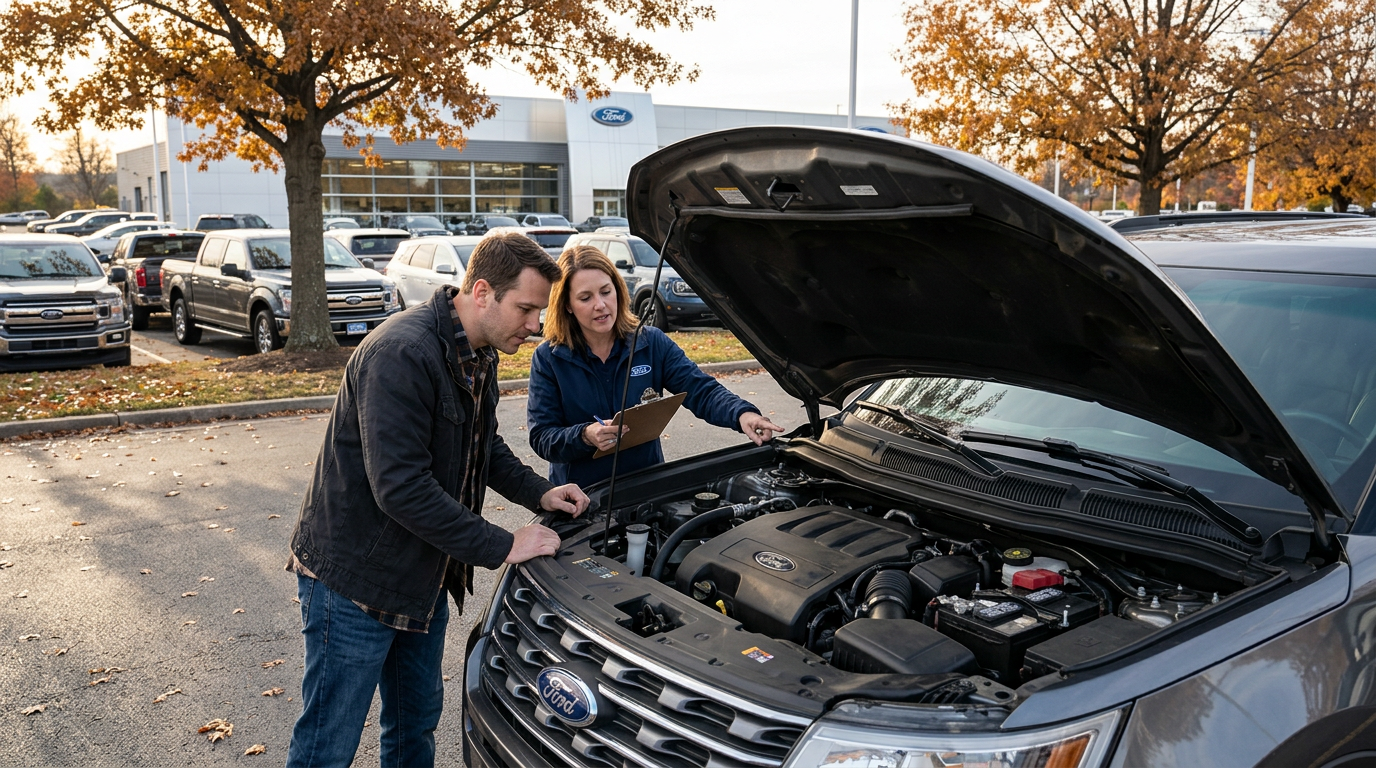
To thoroughly inspect under the hood of a used car, check the engine oil, coolant level and color, brake and power steering fluids, battery terminals, serpentine belts, radiator hoses, and visible gaskets for active leaks or dark sludge. Look closely at the oil cap for milky residue, inspect hose rubber for swelling or cracks, and check for frame damage or fresh fluid drips beneath the engine bay.

Inspection Component Key Warning Signs to Watch For
Engine Oil & Filler Cap Low oil level, dark sludge, or milky residue
Cooling System & Reservoir Rust-colored fluid, low coolant, or bulging hoses
Battery & Electrical Terminals White or green corrosion, loose cables, cracks
Drive Belts & Hoses Fraying, rib cracks, squealing, or soft rubber
Engine Bay & Undercarriage Active drips, burning fluid smell, body filler

Popping the hood provides an immediate window into how well a previous owner maintained the vehicle. Engine components should look weathered from normal driving, but excessive oil grime baked onto the cylinder heads or exhaust manifold points to unaddressed valve cover or head gasket leaks. A spotless, freshly steam-cleaned engine bay can sometimes conceal recent leaks, making a test drive and secondary post-drive visual review essential.

Drivers commuting daily near the St. Jones River corridor put consistent mileage on their powertrains, making detailed mechanical inspections critical for overall vehicle longevity. When examining a pre-owned truck or crossover, check the inner fender wells, strut towers, and front crossmembers for severe rust or frame pull marks that suggest prior structural repairs. Connecting a handheld OBD-II scanner to the diagnostic port under the dash reveals whether computer readiness monitors are complete or if trouble codes were recently cleared.

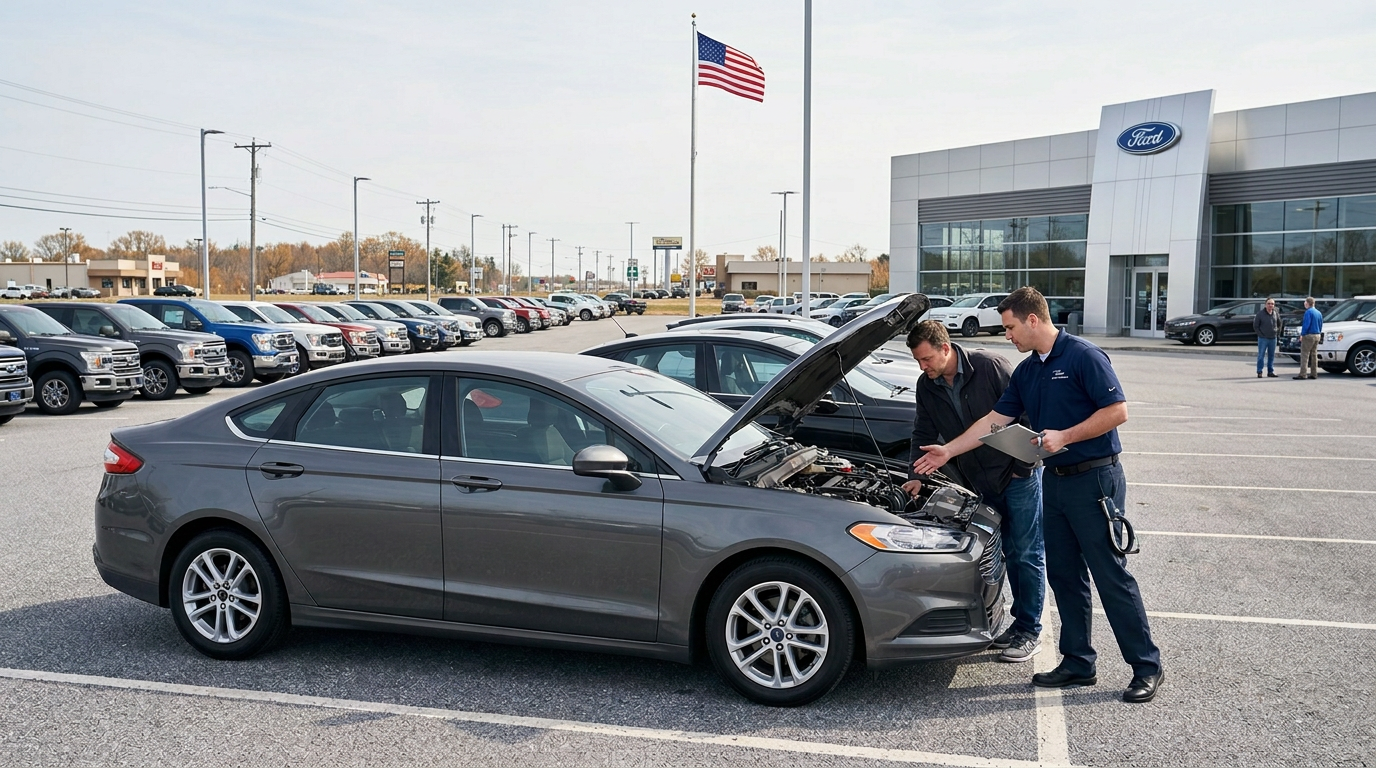
Our team at Winner Ford conducts rigorous multi-point mechanical inspections on every pre-owned model entering our lot to ensure complete reliability. If you want expert help reviewing pre-owned inventory or scheduling a professional lift inspection, contact our sales desk at (302) 734-0444 or drop by our showroom address at 591 S Dupont Hwy.

Table of Contents

How Do You Inspect Engine Fluids, Batteries, and Belts for Hidden Wear?

Evaluating fluid health, battery terminals, and rubber belt condition requires checking fluid colors, measuring battery resting voltage, and feeling rubber hoses for soft spots or cracks. Clean engine oil shows a transparent amber hue, while dark, thick sludge indicates extended drain intervals and internal wear.

  • Engine Oil Level and Quality: Pull the dipstick with the vehicle parked on level ground and the engine off. Wipe it clean, reinsert it fully, and pull it out to verify the oil falls between the minimum and maximum indicator marks. Dark, tar-like oil or heavy sludge on the dipstick indicates deferred maintenance.
  • Cooling System and Overflow Tank: Inspect the translucent coolant expansion tank when the engine is completely cold. Coolant should reach the indicated fill line and feature a clean bright green, orange, or pink color. Rust-colored water, oily film floating on top, or white powder near radiator hose clamps signals internal corrosion or blown gaskets.
  • Brake, Transmission, and Steering Fluids: Brake fluid should appear light amber in a clear reservoir. Power steering fluid and transmission fluid—where dipsticks are accessible—should carry a reddish or translucent shade without a burnt odor.
  • Serpentine Belts and Hoses: Inspect accessible belts for rib cracking, fraying along the edges, or uneven wear. AAA recommends evaluating belts and hoses twice a year or alongside routine oil services. Squeeze upper and lower radiator hoses cold; they should feel firm yet flexible rather than rock-hard, brittle, or mushy.
  • Battery Terminals and Connections: Inspect battery posts for white or greenish corrosion crust. A multimeter connected across the terminals should show a resting charge around 12.6 volts.

Replacing worn belts, air filters, or aged batteries before trouble starts helps preserve long-term engine performance. If you need replacement filters, factory-specified fluids, or fresh battery connections, our parts center stocks genuine OEM components built for your exact make and model.


How Do You Verify a Clean Title and Accident History in Delaware?

Verifying a clean vehicle history in Delaware requires matching the 17-digit vehicle identification number (VIN) across digital history reports while physically examining the Delaware paper title for salvage, rebuilt, or flood brandings. Digital vehicle history providers aggregate official police crash reports, insurance total-loss filings, and state titling transfers.

A clean digital vehicle history report provides valuable insight into prior ownership count, registration history, and reported collision damage. However, private out-of-pocket body repairs or minor cosmetic incidents are not always reported to national databases. Combining a digital history search with a physical inspection ensures no hidden structural issues slip past.

Inspect body panel gaps along the hood, doors, and front fenders. Uneven spacing or misaligned panels point to prior body repairs. Check factory paint depth across metal panels; inconsistent thickness or overspray on rubber door seals indicates repainted sections. Looking under the hood at the inner fender aprons and frame rails reveals whether factory spot welds remain intact or if aftermarket pull marks exist.


How Can You Estimate Out-the-Door Used Car Prices?

Estimating the true out-the-door price for a pre-owned car requires combining the agreed-upon vehicle price with Delaware's mandatory 4.25% motor vehicle document fee, state title and registration charges, and dealer processing fees. Delaware does not charge a general state sales tax on vehicle purchases, but the document fee applies to almost every vehicle transfer.

Calculated on the net purchase price after trade-in allowances, the state document fee rewards buyers who trade in a vehicle. For instance, purchasing a pre-owned SUV at $22,000 without a trade-in incurs an $935 state document fee ($22,000 multiplied by 0.0425). Adding Delaware's standard $55 certificate of title fee (for vehicles with a lien) and the $40 annual registration fee brings total state government fees to $1,030.

Expense Line Item Estimated Amount / Calculation Basis
Negotiated Vehicle Price Base selling price of the pre-owned vehicle
Net Trade-In Deduction Subtracts trade-in value from taxable baseline
DE Motor Vehicle Document Fee 4.25% of net price difference after trade-in
Delaware Title Fee $55 (standard rate for active lien issuance)
Delaware Annual Registration Fee $40 (standard annual passenger vehicle rate)
Dealer Processing Fee Administrative fee for titling and paperwork

When commuters driving south along Route 13 from Middletown calculate their buying power, factoring in trade-in credit delivers immediate savings on state fees. Trading in a vehicle valued at $8,000 against a $22,000 purchase price drops the taxable baseline to $14,000, lowering the 4.25% motor vehicle document fee down to $595 and saving $340 in state charges.

Reviewing transparent itemized figures ensures complete clarity before signing purchase agreements. You can explore our extensive inventory of quality pre-owned inventory online to compare models and review detailed pricing breakdowns before visiting.


Do Used Cars in Delaware Require Safety Inspections or Emissions Testing?

Every used vehicle being titled or renewed in Delaware must pass a comprehensive safety inspection and emissions test at an official Division of Motor Vehicles facility before permanent license plates are issued. State inspection lanes evaluate critical mechanical systems at no cost to the driver.

The safety portion of the inspection covers functional checks on headlights, brake lights, turn signals, horn operation, windshield wiper blades, and emergency brake holding capacity. DMV technicians also measure tire tread depth and check underbody frame components, exhaust hangers, and suspension linkages for severe rust or damage.

Emissions testing depends on the vehicle's model year and engine type:

  • 1996 and Newer Gasoline Vehicles: Tested using an OBD-II computer diagnostic scan that verifies readiness monitors and ensures no active check engine codes are stored.
  • Pre-1996 Gasoline Models: Evaluated using a curb-idle exhaust pipe analyzer and gas cap pressure test.
  • Diesel Models (1997 and Newer up to 8,500 lbs GVWR): Subject to OBD-II diagnostic scans to confirm proper emissions system function.

Purchasing a vehicle through Winner Ford removes the stress of state testing, as our pre-owned inventory is thoroughly inspected to satisfy Delaware requirements prior to sale. If your current vehicle needs preventive care or brake service, you can easily schedule a service appointment with our certified technicians.


Can You Start Trade-In and Financing Online for Pre-Owned Vehicles?

Starting the used car purchasing process online allows buyers to evaluate trade-in values, explore financing options, and submit credit applications from home. Modern digital shopping tools streamline paperwork, reducing time spent at the dealership while providing clear financial visibility.

Online trade-in valuation tools calculate real-time market estimates based on vehicle year, mileage, trim level, and physical condition. Submitting accurate details regarding tire wear, interior cleanliness, and service records yields precise trade valuations that apply directly toward your pre-owned purchase, reducing your taxable baseline under Delaware law.

Completing a digital pre-qualification or full credit application allows finance specialists to secure competitive interest rates tailored to your budget. Online shoppers can compare financing options across multiple pre-owned models, evaluate optional extended protection plans, and reserve vehicles for an in-person test drive.

Whether you are looking at pre-owned crossovers or browsing our new vehicle inventory for comparison, our digital tools make planning effortless. You can start right now to value your trade-in online or submit a secure form to apply for financing before stepping onto the lot.


What Questions Do Buyers Ask Most About Used Car Inspections in Delaware?

Q: What does a milky appearance under the oil cap mean during an under-hood inspection?

A: A milky, yellowish sludge beneath the engine oil cap usually indicates coolant mixing with engine oil, which points to a blown head gasket, cracked cylinder head, or damaged engine block. While short winter drives can sometimes cause harmless condensation under the cap, persistent milky residue on the oil dipstick indicates serious internal engine damage that requires immediate professional evaluation.

Q: How long do you have to register a newly purchased used car in Delaware before facing penalties?

A: Delaware law requires buyers to title and register newly acquired pre-owned vehicles within 30 days of the purchase date to avoid late penalty fees. New Delaware residents transferring out-of-state titles have up to 60 days from establishing residency to complete registration. Licensed dealerships issue 30-day temporary registration tags at the point of sale while handling permanent titling paperwork with the state.

Q: Does Delaware's Lemon Law cover pre-owned vehicles purchased as-is?

A: Delaware's Lemon Law applies almost exclusively to new vehicle purchases, meaning pre-owned cars bought without an active factory warranty receive no statutory lemon law protections. Used vehicles purchased with an "as-is" FTC Buyer's Guide window sticker place full financial responsibility for post-sale repairs on the buyer. Buyers seeking long-term coverage should choose manufacturer-backed certified pre-owned vehicles or option written extended service contracts.

Q: How do you test if a serpentine belt needs immediate replacement on a used car?

A: Inspect the ribbed side of the belt using a flashlight with the engine turned off. If you observe three or more cracks within a one-inch segment, visible fraying along the outer fabric edges, missing rib chunks, or notice loud squealing noises during engine startup, the belt requires immediate replacement. AAA recommends inspecting drive belts during routine twice-yearly maintenance visits.

Q: What documents should you bring to the dealership when completing a pre-owned vehicle purchase?

A: Buyers should bring a valid driver's license, proof of active Delaware auto insurance, payment for down payment or state fees, and the title or registration for any trade-in vehicle. Buyers applying for auto financing should also bring recent pay stubs for income verification, a recent utility bill for proof of residency, and contact information for personal references.

Planning your next pre-owned vehicle purchase is simple when you partner with a trusted dealership. For personalized guidance or to schedule a test drive, visit our dealership on Dupont Highway or give our team (302) 734-0444 to explore our complete used car inventory today.


© 2026 Winner Ford. All rights reserved.

Posted in:

Related Posts

Winner_Ford_of_Dover_Used_Car_Buying_Guide

What Should You Check Before Buying a Used Car in Dover, DE?

Before buying a pre-owned vehicle, you should review a vehicle history report, inspect the frame and body, check tire wear and brake condition, verify service records, evaluate cabin electronics, and conduct a thorough road test. Confirming that the car passes state safety and emissions standards ensures dependable operation on every drive. Evaluating a pre-owned vehicle requires a methodical walk-around to confirm its safety and overall mechanical condition. Start by examining exterior body panels for inconsistent paint textures, misaligned gaps, or undercarriage rust that could signal past collision damage. Check fluid levels under the hood, noting the color and condition of engine oil, transmission fluid, and coolant. Inspect the tread depth and wear patterns on all four tires, as uneven wear often points to alignment or suspension issues. When you get inside the cabin, verify that electronic features operate properly. Test the climate control system, touchscreens, power windows, seat adjustments, and active safety systems like blind-spot monitoring and adaptive cruise control. During your road test, pay attention to engine responsiveness, transmission shift smoothness, brake pedal firmness, and steering feedback over varied pavement surfaces. State government employees and daily commuters in Dover need a vehicle that delivers steady fuel efficiency and complete comfort on everyday drives. Our team recommends verifying all maintenance records to ensure previous oil changes, fluid flushes, and scheduled services occurred on time. You can visit our showroom on South Dupont Highway to inspect high-quality pre-owned options, or reach out directly by giving our team a call at (302) 734-0444 to schedule a personalized consultation. Table of Contents What Is Considered Good Mileage for a Used Car? Is It Better to Buy a Used Car from a Dealer or a Private Seller in Delaware? How Can Buyers Determine Fair Market Value and Negotiate Used Car Pricing? How Do Delaware Document Fees, Registration Costs, and Taxes Impact Used Car Buyers? Are Factory Certified Pre-Owned Warranties Transferable to Subsequent Buyers? Common Questions About Buying a Used Car Drive Away with Confidence at Winner Ford What Is Considered Good Mileage for a Used Car? A standard benchmark for a used car is an average of 12,000 to 15,000 miles per year of age. Under this rule of thumb, a five-year-old pre-owned vehicle with 60,000 to 75,000 miles on the odometer is considered to have normal, acceptable mileage. While odometer numbers provide a starting point, vehicle condition, maintenance history, and driving conditions matter just as much as total mileage. A vehicle driven 80,000 miles mostly on open highways often experiences less engine and brake wear than a vehicle driven 50,000 miles in constant stop-and-go city traffic. Highway driving lets engines operate at consistent temperatures with fewer gear changes, preserving critical components over time. Modern engineering standards allow well-maintained vehicles to comfortably reach 150,000 to 200,000 miles without major mechanical failures. When evaluating pre-owned vehicles, look for models equipped with durable engine options like Ford EcoBoost technology, which balances responsive acceleration with engine longevity. Regular maintenance—such as timely oil changes, filter replacements, and transmission services—plays a far greater role in long-term reliability than the initial number on the dash. Low Mileage (Under 30,000 miles): Often commands higher pricing but comes with minimal component wear and remaining factory warranty coverage. Moderate Mileage (30,000 to 75,000 miles): Strikes a strong balance between initial cost savings, reliable performance, and remaining service life. Higher Mileage (75,000+ miles): Offers maximum affordability, making it ideal for budget-conscious buyers who prioritize consistent service records over low odometer readings. Exploring our pre-owned vehicle lineup gives you access to thoroughly inspected options across various mileage bands and price points. Is It Better to Buy a Used Car from a Dealer or a Private Seller in Delaware? Purchasing a used car from an established dealership offers vehicle reconditioning, structured consumer protections, flexible financing options, and trade-in convenience that private sales cannot match. While private sellers might list lower asking prices, those vehicles are sold strictly as-is, leaving buyers with no warranty protection or legal recourse. Dealerships perform detailed multi-point inspections on every vehicle before placing it on the lot. Factory-trained technicians inspect mechanical systems, replace worn brake pads or tires, recondition interior surfaces, and ensure all safety equipment meets strict standards. Dealerships also handle complex legal paperwork—including title transfers, lien payoffs, and registration processing—saving you time and preventing title defects. Private transactions carry inherent risks for buyers. Private sellers generally do not provide vehicle history reports, detailed repair records, or post-purchase protection. If a mechanical issue develops immediately after money changes hands, the buyer bears the full repair cost. Furthermore, private transactions require cash payments or securing independent personal loans, whereas dealerships partner with multiple financial institutions to craft payment structures customized for your family's budget. Families taking weekend trips to community parks around Middletown benefit from the added peace of mind that comes with a dealership-inspected vehicle. If you are comparing pre-owned value against updated technology, taking a look at our latest new vehicle selection helps clarify feature differences across model years. How Can Buyers Determine Fair Market Value and Negotiate Used Car Pricing? Determining a fair market price requires checking independent valuation tools like Kelley Blue Book, Edmunds, and NADA Guides against local market listings while factoring in vehicle condition, trim level, and total mileage. Buyers can typically negotiate between 3% and 7% off a dealer's listing price depending on market demand, vehicle condition, and inventory age. Automotive market benchmarks provide valuable context during your research phase. Kelley Blue Book reported that the average U.S. used-vehicle listing price reached $27,235 in September 2026, with models priced at $15,000 or less remaining in particularly tight supply. Reviewing market benchmarks helps you identify competitive asking prices for specific trim levels, such as a Ford F-150 equipped with FX4 Off-Road Package upgrades or a Ford Explorer featuring luxury King Ranch trim finishes. Effective negotiation relies on objective data rather than emotional back-and-forth. When negotiating, bring printed or digital market comparisons showing similar models with comparable mileage. Point out practical factors that justify price adjustments, such as upcoming maintenance needs or minor exterior scratches. Valuation Factor Impact on Asking Price Key Consideration Vehicle History Report High Impact Clean title vs. past accidents Service & Maintenance Records Moderate to High Impact Documented timely oil/fluid shifts Overall Mechanical & Body Condition High Impact Wear on tires, brakes, paint finish Local Market Supply & Demand Moderate Impact Regional demand for AWD or trucks Factoring your existing vehicle into the purchase structure can further optimize your final cost. You can value your trade-in online to establish an accurate vehicle equity estimate before finalizing your contract negotiations. How Do Delaware Document Fees, Registration Costs, and Taxes Impact Used Car Buyers? Delaware does not levy a general state sales tax on vehicle purchases, but the state assesses a 5.25% motor-vehicle document fee based on the vehicle purchase price or official valuation upon titling. Factoring in a standard $35 title fee (plus a $20 lien-recording charge when applicable) and an annual $40 registration fee helps buyers calculate their total purchase obligation accurately. Delaware Fee Item Standard Fee Amount Details & Rules Motor Vehicle Document Fee 5.25% of purchase price or valuation Assessed upon titling in Delaware Vehicle Sales Tax 0% (No state sales tax) Delaware levies no general sales tax Certificate of Title Fee $35 standard ($55 with active lien) Mandatory state titling fee Annual Passenger Registration $40 per year Base vehicle registration cost DMV Safety & Emissions Inspection Free at state DMV facilities Conducted at state lanes like Dover Understanding how trade-in vehicles affect document fee calculations offers substantial financial savings. Delaware law allows the agreed trade-in value of your current car to be subtracted from the purchase price of your replacement vehicle before calculating the 5.25% motor-vehicle document fee. For example, if you purchase a pre-owned vehicle for $25,000 and trade in your current vehicle for $10,000, the 5.25% document fee applies only to the net $15,000 difference. Out-of-state buyers purchasing a vehicle in Delaware do not pay Delaware's document fee. Instead, out-of-state buyers pay applicable sales taxes, document fees, and registration costs in their home state when registering the car locally. In addition, Delaware conducts safety and emissions testing at state DMV facilities—including the Dover station—free of charge, helping buyers verify compliance before completing official paperwork. Preparing your budget is easier when you map out terms early. Take a few minutes to get pre-approved by submitting an online credit application with our finance department. Are Factory Certified Pre-Owned Warranties Transferable to Subsequent Buyers? Most factory Certified Pre-Owned (CPO) warranties transfer directly to subsequent private buyers during the active coverage period. Program structures like Ford Blue Advantage allow coverage to pass to a new owner, sometimes requiring a minor administrative processing fee. Factory CPO programs offer layered protection that mimics new-vehicle peace of mind. Under the Ford Blue Advantage system, vehicles earn certification under specific tiers based on age and mileage: Gold Certified: Covers Ford models up to 6 model years old with less than 80,000 miles. Includes a 12-month/12,000-mile comprehensive limited warranty, a 7-year/100,000-mile powertrain limited warranty, and 24/7 Ford Roadside Assistance. Blue Certified: Covers any make and model up to 10 model years old with less than 120,000 miles. Includes a 90-day/4,000-mile comprehensive limited warranty and roadside support. Transferable warranty coverage preserves resale value over time. If you decide to sell your certified vehicle privately after a few years, transferring the remaining factory powertrain warranty gives prospective buyers heightened confidence, helping your listing stand out in a competitive market. If you ever require towing, battery jump-starts, or fuel delivery during an active roadside coverage period, you can reach manufacturer support directly via Ford Roadside Assistance: 1-800-241-3673. Common Questions About Buying a Used Car Q: Do out-of-state buyers pay Delaware document fees when purchasing a used car? Out-of-state buyers do not pay Delaware's 5.25% motor-vehicle document fee when purchasing a used vehicle in Delaware. Instead, the dealership coordinates out-of-state titling paperwork so you pay your home state's required sales taxes, titling charges, and registration fees when the vehicle is registered in your home state. Q: How does trading in a car lower the taxable total in Delaware? Delaware allows the agreed trade-in value of your current vehicle to be deducted directly from the purchase price of the replacement vehicle prior to fee calculation. The 5.25% motor-vehicle document fee is then calculated solely on the remaining net balance, saving you money on your total transaction. Q: Are vehicle inspections mandatory before registering a pre-owned car in Delaware? Yes, Delaware requires all pre-owned vehicles to pass a safety inspection and emissions test at a state DMV facility before issuing official registration tags. Delaware DMV locations, including the facility in Dover, perform these inspections free of charge to vehicle owners. Q: What paperwork should buyers bring to the dealership when financing a used car? Buyers applying for financing should bring a valid driver's license, current proof of auto insurance, your most recent pay stubs or proof of income, proof of residence (such as a utility bill), and title/registration documents for any vehicle you plan to trade in. Bringing these complete documents speeds up credit approval processing. Q: Can a used vehicle warranty be extended past its initial term? Yes, buyers can opt to purchase extended service plans at the time of purchase to protect critical mechanical components after factory or CPO warranties expire. Extended protection coverage can be tailored for specific term lengths and mileage limits, giving your family long-term financial predictability. For personalized answers to specific inventory questions or to arrange a walk-around, visit our dealership address in Dover or call our team directly at (302) 734-0444. Drive Away with Confidence at Winner Ford Finding the ideal pre-owned car, truck, or SUV requires balancing reliable performance, transparent market pricing, and flexible payment plans tailored to your budget. Whether you need a fuel-efficient Ford Escape for daily work travel or a rugged Ford F-150 equipped for weekend towing projects, choosing a vehicle backed by comprehensive inspections gives you complete confidence on the road. Our team believes in delivering an easygoing car-buying experience focused entirely on your needs. As a second-generation family-owned business, we strive to build lifelong relationships across our local community by providing honest advice, reliable vehicles, and straightforward financing options. Explore our current pre-owned inventory online, schedule a convenient test drive, or stop by to speak with our knowledgeable team today. Your next adventure begins with a reliable vehicle built to keep your family safe on every mile of the journey ahead. Keep Your Vehicle Running Strong Keep your vehicle performing at its best with our service team: Schedule Service Parts Department © 2026 Winner Ford. All rights reserved.

Winner_Ford_of_Dover_Ford_F-150_FAQs_October_2026

Unlock Ultimate Power and Tech: Why the 2026 F-150 Dominates Towing and Innovation

The 2026 Ford F-150 outperforms full-size pickup rivals like the Ram 1500 and Chevrolet Silverado by delivering a best-in-class maximum gas towing capacity of 13,500 lbs, a best-in-class maximum payload of 2,440 lbs, and six powerful engine choices. Standard equipment includes a 12-inch touchscreen running SYNC 4 software and available BlueCruise hands-free driving technology, making it the most versatile and technologically complete truck in its segment. When comparing full-size trucks, capability and engineering flexibility set the F-150 apart. While the Ram 1500 focuses heavily on passenger ride comfort with its coil-spring suspension, the F-150 maintains a clear advantage in maximum trailering limits and work-site utility. Features like Pro Power Onboard turn the truck bed into an electrical power source, allowing drivers to run heavy-duty power tools or camping appliances directly from the bed outlets without bringing a standalone generator. Against the Chevrolet Silverado and Toyota Tundra, the F-150 offers greater powertrain diversity. Buyers can choose between efficient twin-turbo V6 engines, a naturally aspirated 5.0L V8, and the advanced 3.5L PowerBoost Hybrid that outputs 430 hp and 570 lb-ft of torque. Inside the cabin, every 2026 model comes equipped with a 12.0-inch digital instrument cluster alongside the central infotainment display, ensuring seamless smartphone integration via wireless Apple CarPlay and Android Auto. For truck buyers navigating the mixed terrain around Middletown, whether hauling boat trailers toward local waterways or managing equipment between job sites, the F-150 provides the ideal balance of rugged durability and modern comfort. To explore these capability advantages in person, stop by our showroom location on South Dupont Highway or get in touch by giving our team a call. Table of Contents What Are the 2026 Ford F-150 Engine Options and Horsepower Ratings? What Are the Key Trim Level Differences Across the 2026 F-150 Lineup? What Cab Styles and Bed Lengths Are Available on the 2026 F-150? How Can You Trade In Your Used Truck at Winner Ford? Frequently Asked Questions About the 2026 Ford F-150 Find Your Ideal 2026 Ford F-150 Trim at Winner Ford What Are the 2026 Ford F-150 Engine Options and Horsepower Ratings? The 2026 Ford F-150 engine lineup offers six distinct power plants paired with a SelectShift 10-speed automatic transmission, generating between 325 hp and 700 hp. Available powertrains include the standard 2.7L EcoBoost V6 producing 325 hp and 400 lb-ft of torque, the iconic 5.0L V8 delivering 400 hp and 410 lb-ft, the twin-turbo 3.5L EcoBoost V6 with 400 hp and 500 lb-ft, and the 3.5L PowerBoost Hybrid generating 430 hp and 570 lb-ft of torque. Selecting the right engine depends on how you plan to use your truck: 2.7L EcoBoost V6: Standard on XL, STX, and XLT trims, this twin-turbo V6 makes 325 hp and 400 lb-ft of torque. It delivers excellent low-end response for daily driving and light hauling. 5.0L V8: Available on XL, XLT, Lariat, and Tremor, this naturally aspirated motor pumps out 400 hp and 410 lb-ft of torque. It is favored by buyers who prefer traditional linear power delivery and a classic V8 exhaust note. 3.5L EcoBoost V6: Standard on King Ranch and Platinum trims, and available on XLT, Lariat, and Tremor, this engine produces 400 hp and 500 lb-ft of torque for effortless heavy-duty towing. 3.5L PowerBoost Hybrid: Available across mid- and high-level trims, this hybrid pairs the 3.5L twin-turbo engine with an electric motor to generate 430 hp and 570 lb-ft of torque while achieving an EPA-estimated 22 city / 24 hwy mpg. High-performance specialized engines include the 3.5L High-Output EcoBoost V6 in the Raptor rated at 450 hp and 510 lb-ft, and the supercharged 5.2L V8 in the Raptor R generating 700 hp and 640 lb-ft of torque. Whether you prioritize highway fuel efficiency or maximum pull for heavy trailers, our team can help you structure your purchase through an online credit application before visiting the showroom. How Can You Trade In Your Used Truck at Winner Ford? You can trade in your current pre-owned truck or car at Winner Ford by getting an instant market valuation online or bringing your vehicle directly to our appraisal center. Our team uses current regional sales transactions and live market data to calculate a top-dollar appraisal that can be applied directly toward down payment costs on a new 2026 F-150. Trading in your vehicle at our dealership offers several distinct benefits: Tax Savings: In Delaware, the value of your trade-in is deducted from the purchase price of your new truck, reducing the overall vehicle price subject to transaction fees. Hassle-Free Process: Avoid the safety concerns, lowball inquiries, and delayed payments associated with selling to private buyers. Loan Payoff Handling: If you still owe money on your current vehicle, our finance team can work directly with your lender to pay off the balance and roll any remaining equity into your new purchase. To get started today, explore our diverse pre-owned truck inventory to see what pre-owned models are selling for, or take two minutes to value your trade online before stopping by our showroom. Frequently Asked Questions About the 2026 Ford F-150 Q: What is Ford Pro Power Onboard and how does it function on the 2026 F-150? Pro Power Onboard turns the 2026 F-150 into a mobile generator, offering power outputs ranging from 2.0 kW on standard gas engines up to 7.2 kW on the 3.5L PowerBoost Hybrid. The 7.2 kW system features multiple 120V outlets and a 240V 30-amp outlet in the truck bed, allowing you to run heavy construction equipment, power tools, air compressors, or camping gear simultaneously without towing a separate generator. Q: Does the 2026 F-150 offer hands-free highway driving capabilities? Ford BlueCruise hands-free driving is available on select 2026 F-150 trims, including Lariat, King Ranch, and Platinum. The technology operates on over 130,000 miles of designated North American highways, controlling steering, braking, and acceleration while monitoring driver attention. It includes lane-changing assistance and in-lane repositioning to safely keep space from oversized trucks in neighboring lanes. Q: How does the Pro Access Tailgate operate on the 2026 F-150? The available Pro Access Tailgate incorporates a driver-side swinging door built directly into the traditional fold-down tailgate structure. The center door opens sideways at 37, 70, or 100 degrees, letting you step closer to the truck bed to reach cargo without leaning over an extended tailgate or unhooking a connected trailer hitch. Q: What warranty coverage comes standard with a new 2026 Ford F-150? Every new 2026 Ford F-150 includes a 3-year/36,000-mile bumper-to-bumper limited warranty alongside a 5-year/60,000-mile powertrain limited warranty. Models outfitted with the 3.5L PowerBoost Hybrid also receive 8 years or 100,000 miles of specialized hybrid component coverage, supported by 24-hour Ford Roadside Assistance for complete peace of mind. Q: What documents should I bring when purchasing or financing a new F-150 at the dealership? When visiting our dealership to finalize your purchase, bring a valid driver's license, your current vehicle registration card, and proof of auto insurance. If you intend to trade in a vehicle or apply for dealer financing, bring your current vehicle title or loan payoff information, along with recent pay stubs and proof of residency to accelerate approval. Find Your Ideal 2026 Ford F-150 Trim at Winner Ford Winner Ford offers personalized consultations to help you select the perfect 2026 Ford F-150 trim, cab style, and engine to fit your specific needs and budget. From the functional XL starting at $39,585 MSRP for the base configuration to the luxurious Platinum and off-road ready Tremor, our dealership carries a comprehensive selection tailored to local driving needs. Our knowledgeable sales team is committed to providing a transparent, straightforward shopping experience without pressure. We invite you to visit our Dover dealership showroom to see the lineup in person, compare features side-by-side, and test-drive your preferred trim. Give us a call at (302) 734-0444 or stop by today to take the next step toward owning America's favorite pickup truck. Keep Your Vehicle Running Strong Keep your vehicle performing at its best with our service team: Schedule Service Parts Department © 2026 Winner Ford. All rights reserved. Vehicle specification data © JATO Dynamics Limited.

Winner_Ford_of_Dover_Explorer_Test_Drives_October_2026

How Does the 2026 Ford Explorer Compare to Midsize Rivals?

The 2026 Ford Explorer distinguishes itself from midsize three-row rivals like the Toyota Highlander, Honda Pilot, and Kia Telluride through its rear-wheel-drive-based architecture, higher standard horsepower, and robust towing capability. Delivering 300 horsepower from its standard 2.3L EcoBoost four-cylinder engine and up to 400 horsepower from an available 3.0L EcoBoost V6, the Explorer outperforms most competitors in acceleration and driving dynamics while offering a standard Class III Trailer Tow Package rated for up to 5,000 pounds. While many front-wheel-drive competitors prioritize softer highway cruising, the Explorer’s platform provides dynamic cornering stability and precise steering control. For active households needing versatile cargo arrangements and confident foul weather capability, this balance of power and handling makes the Explorer a top contender in the family SUV segment. To explore current availability or arrange a test drive, shoppers can easily view our Dover showroom location or reach our sales department by calling (302) 734-0444. Built for Family and Adventure, the Explorer combines modern utility with athletic performance. Table of Contents What Engine Options, Towing Specs, and Drivetrains Define the 2026 Ford Explorer? How Does the 2026 Ford Explorer Compare to the Toyota Highlander? What Audio Systems and Interior Technology Are Available in the 2026 Ford Explorer? What Is the Expected Reliability Rating of the 2026 Ford Explorer? Should You Buy a 2026 Ford Explorer or Wait for the 2027 Model? Common Questions About the 2026 Ford Explorer Experience the 2026 Ford Explorer at Winner Ford What Engine Options, Towing Specs, and Drivetrains Define the 2026 Ford Explorer? The 2026 Ford Explorer offers two powerful EcoBoost gas engines, standard rear-wheel drive or available Intelligent 4WD, and a 5,000-pound maximum towing capacity across its lineup when equipped with the standard Class III Trailer Tow Package. Powertrain choices begin with a 2.3L EcoBoost turbocharged four-cylinder producing 300 hp and 310 lb-ft of torque, while higher trims like the ST and optional Tremor upgrades feature a 3.0L EcoBoost twin-turbo V6 generating 400 hp and 415 lb-ft of torque. Both engines pair exclusively with a SelectShift 10-speed automatic transmission that delivers smooth, crisp shifts during daily commutes and heavy hauling alike. Rear-wheel drive comes standard on the Active, ST-Line, Platinum, and ST trims, providing athletic driving dynamics and an EPA-estimated 20 mpg city / 29 mpg highway on the 2.3L model. For enhanced traction during rain or winter weather, Intelligent 4WD is available across the board and comes standard on the rugged Tremor trim. Shoppers seeking a hybrid powertrain should note that Ford has streamlined consumer Explorer models around these two EcoBoost gas engines, discontinuing the consumer hybrid option for the 2026 model year. Buyers evaluating earlier model years or pre-owned options can inspect our selection of pre-owned vehicles to compare different powertrain generations side by side. Key mechanical highlights across the 2026 Explorer lineup include: 2.3L EcoBoost I-4: 300 hp / 310 lb-ft of torque (standard on Active, ST-Line, Tremor, Platinum). 3.0L EcoBoost V6: 400 hp / 415 lb-ft of torque (standard on ST; available on Tremor, Platinum). SelectShift 10-speed automatic transmission standard on all trims. Standard Class III Trailer Tow Package supporting up to 5,000 lbs max towing capability. How Does the 2026 Ford Explorer Compare to the Toyota Highlander? With a 300-horsepower turbocharged engine and a 10.1-inch touchscreen, the 2026 Ford Explorer offers features that appeal to drivers seeking power and tech upgrades over competitors like the Toyota Highlander. Starting at a competitive base MSRP of $38,465 for the Active 100A RWD trim (plus $1,795 destination charge), the Explorer delivers 300 hp standard compared to the Highlander's 265-hp four-cylinder engine. On the road, the Explorer’s rear-wheel-drive platform provides more responsive steering and balanced handling than the Highlander's front-wheel-drive setup. When properly equipped, every 2026 Explorer can tow up to 5,000 lbs, outmatching the Highlander's standard 3,500-pound limit. Inside the cabin, Ford equips every Explorer with a massive 13.2-inch touchscreen powered by the Ford Digital Experience, providing integrated Google Maps and Google Assistant controls that surpass the smaller standard displays found in the Highlander. While the Highlander holds an edge in fuel economy via its available hybrid powertrain, the Explorer delivers a far more engaging driving experience and superior utility. Families engaging in weekend boating or camping trips near Middletown find that the Explorer’s 5,000-lb towing rating and expansive rear cargo space easily accommodate heavy gear. To keep your current vehicle running at peak efficiency before upgrading, consider scheduling a service appointment with our certified maintenance team. What Audio Systems and Interior Technology Are Available in the 2026 Ford Explorer? The 2026 Ford Explorer comes standard with the Ford Digital Experience, operating on a 13.2-inch center touchscreen paired with a 12.3-inch digital instrument cluster, accompanied by three distinct audio system configurations across the trim lineup. Base configurations feature a clear six-speaker audio setup, mid-tier models offer a 10-speaker B&O Sound System by Bang & Olufsen, and top trims can be equipped with a premium 14-speaker, 980-watt B&O Sound System. The Ford Digital Experience integrates Google Maps directly into the primary screen and digital gauge display, giving drivers seamless navigation alongside hands-free Google Assistant voice commands and Google Play app downloads. Wireless Apple CarPlay and Android Auto compatibility come standard, allowing effortless smartphone connectivity without messy charging cables. Eight USB-C ports distributed across all three rows ensure every passenger stays powered on long road trips. Upgrading to higher trims like the ST-Line or Tremor Ultimate Package unlocks the 14-speaker B&O Sound System by Bang & Olufsen, which delivers rich, immersive audio tailored specifically to the Explorer’s cabin acoustics. Dependable Performance meets Modern Technology throughout the interior, giving drivers intuitively designed controls alongside cutting-edge connectivity. If you plan to trade in your current vehicle toward an upgraded tech package, start by evaluating your trade-in online. What Is the Expected Reliability Rating of the 2026 Ford Explorer? The 2026 Ford Explorer is expected to achieve above-average overall reliability, backed by a J.D. Power Quality & Reliability rating of 85 out of 100 ("Great") and an overall score of 83 out of 100. This strong rating reflects the mature engineering of Ford’s sixth-generation Explorer platform, which benefited from significant build-quality refinements and electronic software enhancements introduced during its recent mid-cycle refresh. In long-term owner tracking and consumer evaluations, such as Kelley Blue Book reviews, the current Explorer generation maintains a 3.6 out of 5-star reliability rating, with owners praising its robust EcoBoost engines, smooth SelectShift transmission, and durable interior materials. Every new 2026 Explorer comes protected by a comprehensive factory warranty suite: 3-year / 36,000-mile Bumper-to-Bumper Limited Warranty. 5-year / 60,000-mile Powertrain Limited Warranty. 5-year / 60,000-mile Safety Restraint System Coverage. 5-year / Unlimited-mile Corrosion Perforation Warranty. For added confidence on every journey, Ford includes 5 years or 60,000 miles of 24/7 roadside assistance. In event of a flat tire, dead battery, or unexpected breakdown, drivers can contact Ford Roadside Assistance at (800) 241-3673 for prompt, factory-backed emergency support using genuine Ford components. Daily commuters traveling along busy highway routes near Smyrna rely on this proven mechanical dependability and comprehensive coverage for hassle-free ownership. For ongoing vehicle upkeep or DIY maintenance, our team makes sourcing components simple through our online Ford parts department. Drive Confidently with Ford’s Advanced Safety Features and proven mechanical build quality. Safety & Driver Assistance Safety and driver-assistance features by trim All trims come with Anti-lock Braking System (ABS) and feature height-adjustable front and rear head restraints with two head restraints in the front and two in the rear for most trims, except for ST-LINE 4WD, ST-LINE RWD, and Utility Police Interceptor 4x4 which have three rear head restraints. Additionally, all trims except Utility Police Interceptor 4x4 include ISOFIX preparation, advanced auto collision notification telematics, a millimeter-wave sensor for distance and object sensing, emergency call, and an accident data recorder. All models are equipped with driver and passenger front seat belts that are height adjustable and have pre-tensioners. Every trim is equipped with third-row seating that includes two height-adjustable head restraints and standard seat belts for both driver and passenger positions, except the Utility Police Interceptor 4x4 which does not list third-row head restraints as standard. Standard seat belts are also provided in the rear seat positions for both driver and passenger across all trims. Anti collision features such as brake light activation, automatic emergency braking, and a driver monitor system are standard equipment on all trims. However, low-speed front automatic braking is only available on Active 4WD, Active 4WD 100A, Active RWD, and Active RWD 100A trims; this feature is not listed as standard on Platinum, Platinum 4WD, ST, ST 4WD, ST-LINE 4WD, ST-LINE RWD, Tremor 4WD, or Utility Police Interceptor 4x4 trims. Should You Buy a 2026 Ford Explorer or Wait for the 2027 Model? Shoppers deciding between buying a 2026 Ford Explorer now or waiting for a 2027 model will find that the 2026 model year offers the ideal combination of recent design updates, current vehicle availability, and clear pricing structure. Because the Explorer underwent a major redesign for 2025 and introduced the off-road Tremor trim for 2026, the incoming 2027 Explorer carries over the exact same underlying architecture, 2.3L EcoBoost and 3.0L EcoBoost engine options, and Ford Digital Experience tech stack. Buying a 2026 model today allows shoppers to take immediate delivery from existing dealership inventory without navigating potential production delays or annual MSRP increases on future model years. The 2026 lineup offers the complete array of desirable features—including available BlueCruise hands-free highway driving, multi-contour massaging front seats, and the 14-speaker B&O Sound System —right now. Shoppers can explore available colors and trim levels today by browsing our new Ford Explorer inventory. Our team provides Flexible Financing Designed for Dover Families to streamline your purchase process, and you can get started anytime by submitting an online credit application. Common Questions About the 2026 Ford Explorer Q: Does the 2026 Ford Explorer offer a hybrid engine option? The 2026 Ford Explorer does not offer a hybrid engine option for retail consumers. Ford streamlined the civilian Explorer lineup around two turbocharged gasoline engines: the standard 2.3L EcoBoost four-cylinder delivering 300 hp and the available 3.0L EcoBoost V6 producing 400 hp. Both engines pair with a SelectShift 10-speed automatic transmission to deliver responsive acceleration and a 5,000-lb maximum tow rating. Q: Is Intelligent 4WD standard or optional on the 2026 Ford Explorer? Rear-wheel drive comes standard on the Active, ST-Line, Platinum, and ST trims of the 2026 Ford Explorer. Intelligent 4WD is available as an option across those models and comes standard on the off-road-focused Tremor trim as well as designated 4WD trim configurations. The Intelligent 4WD system continuously monitors traction and automatically shifts torque between front and rear wheels to optimize grip on slick or unpaved roads. Q: How fast is the 2026 Ford Explorer ST from 0 to 60 mph? The 2026 Ford Explorer ST, equipped with the 400-hp 3.0L EcoBoost V6 engine and standard Intelligent 4WD, accelerates from 0 to 60 mph in approximately 5.2 seconds. This rapid acceleration makes the Explorer ST one of the quickest three-row midsize SUVs in its price class, offering sports-sedan performance alongside six-passenger seating versatility. Q: What safety features are included with Ford Co-Pilot360 Assist+? The standard Ford Co-Pilot360 Assist+ suite includes Pre-Collision Assist with Automatic Emergency Braking, Pedestrian Detection, Blind Spot Information System ( BLIS) with Cross-Traffic Alert, Lane-Keeping System, Rear Parking Sensors, and Adaptive Cruise Control with Lane Centering. Higher trims upgrade to Co-Pilot360 Assist 2.0, adding Evasive Steering Assist, Intersection Assist, and Front Parking Sensors. These integrated driver-assist features actively help keep your family safe on every drive. Q: What is the cargo capacity of the 2026 Ford Explorer with the rear seats folded? The 2026 Ford Explorer provides about 16 cu ft of cargo space directly behind the third row of seats. Lowering the 50/50 split-folding third row expands available cargo volume significantly, while folding both the second and third rows opens up a maximum cargo capacity of about 86 cu ft. An underfloor storage compartment in the rear cargo floor provides additional hidden space for smaller tools or travel gear. Experience the 2026 Ford Explorer at Winner Ford Your Local Ford Experts – Here when you need us and ready to help you discover the perfect 2026 Ford Explorer for your family’s lifestyle. Whether you are interested in the efficient Active trim, the sporty ST-Line, or the trail-ready Tremor, our sales team delivers an easygoing, transparent vehicle shopping experience without any high-pressure tactics. Visit us today to compare trim levels, test drive your favorite EcoBoost engine, and explore custom ordering options. You can easily find our dealership by checking directions to our showroom at 591 S Dupont Hwy or by contacting our team directly to schedule your test drive. © 2026 Winner Ford. All rights reserved. Vehicle specification data © JATO Dynamics Limited.