

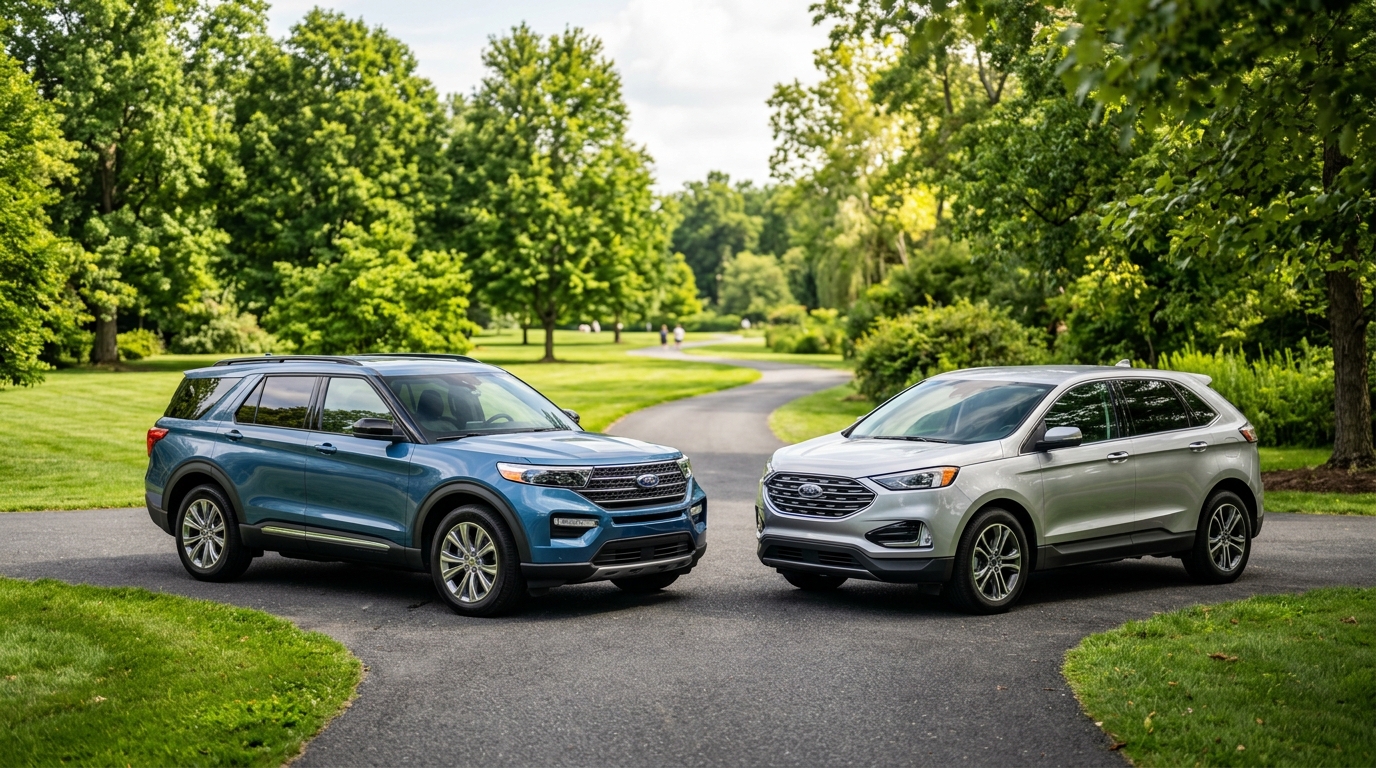
Choosing between the Ford Explorer and Ford Edge comes down to seating needs, drivetrain architecture, and whether you prefer a new factory vehicle or a quality pre-owned model. Buyers needing three rows, seating for up to seven, standard rear-wheel drive, and towing capacities up to 5,000 pounds should choose the 2026 Ford Explorer. Drivers who prefer a maneuverable two-row layout for five passengers, standard Intelligent AWD, and generous second-row legroom will find the Ford Edge to be an ideal pre-owned choice since its North American production ended after the 2024 model year.
The 2026 Explorer represents Ford’s latest engineering, offering versatile family transportation that helps keep your family safe with updated driver-assist systems and modern cabin tech. Built on a rear-wheel-drive platform with available Intelligent 4WD, the Explorer provides truck-like capability for heavy family hauling and trail driving. On the other hand, the Edge sits on a car-based front-wheel-drive architecture that prioritizes a smooth highway ride and easy urban handling.
Our team at Winner Ford helps drivers compare these midsize crossovers side-by-side to find the right fit for their lifestyle. You can browse our broad selection of new vehicles online or reach out directly by dialing (302) 734-0444 to check current vehicle availability. When you are ready for a hands-on vehicle tour, stop by our Dover showroom location to explore both models in person.
Table of Contents
- What Are the Main Powertrain and Towing Differences Between the Explorer and Edge?
- How Do the Dimensions, Seating Capacities, and Cargo Space Compare?
- Why Would Someone Choose the Edge Over the Explorer for Daily Driving?
- Does the Ford Explorer Feature SYNC 4A or the Ford Digital Experience?
- What Is the Price Range Across Trims for the Ford Explorer?
- Frequently Asked Questions About the Ford Explorer and Ford Edge
What Are the Main Powertrain and Towing Differences Between the Explorer and Edge?
The Ford Explorer delivers higher horsepower ratings and a significantly greater towing capacity than the Ford Edge due to its rear-wheel-drive platform and stronger engine options. A standard 2026 Ford Explorer features a 2.3L EcoBoost four-cylinder engine generating 300 horsepower, while higher trims feature a 3.0L EcoBoost V6 producing up to 400 horsepower, both mated to a 10-speed automatic. In comparison, the final-generation Ford Edge came equipped with a standard 2.0L EcoBoost four-cylinder producing 250 horsepower or a 2.7L twin-turbo V6 with 335 horsepower on the performance-focused ST trim, paired with an 8-speed automatic.
Towing performance highlights one of the clearest operational differences between these two utility vehicles. When equipped with the standard Class III Trailer Tow Package, the 2026 Explorer easily pulls up to 5,000 pounds. This capacity makes it the superior vehicle for hauling recreational trailers, camper setups, or watercraft down to coastal launch ramps near Milford. The Ford Edge relies on a lighter Class II setup, capping maximum towing at lower limits better suited for small utility trailers or bike racks.
Drivetrain configurations also serve different driving preferences. Every 2022 to 2024 Ford Edge came standard with Intelligent AWD, making it a secure choice for rainy weather and slick winter roads. The Explorer comes standard with rear-wheel drive for balanced weight distribution, while offering optional Intelligent 4WD and specialized off-road hardware like a TORSEN limited-slip differential on rugged trims such as the Tremor. For buyers considering pre-owned options, evaluating our pre-owned vehicle lineup provides a great opportunity to explore well-maintained Edge models alongside late-model Explorer options.
How Do the Dimensions, Seating Capacities, and Cargo Space Compare?
The Ford Explorer is roughly 10 inches longer overall than the Ford Edge, allowing it to house a third row of seating and expanded total cargo volume. Measuring 199 inches in total length with a 119-inch wheelbase, the Explorer accommodates six or seven passengers across three rows depending on whether you choose second-row captain’s chairs or a full bench. The Ford Edge measures 189 inches in length with a 112-inch wheelbase, dedicated entirely to a spacious two-row, five-passenger cabin layout.
When comparing cargo flexibility, both SUVs offer impressive utility but distribute space differently:
- Ford Explorer Maximum Cargo: Offers up to 86 cubic feet of space with both the second and third rows folded flat, along with about 18 cubic feet behind the upright third row.
- Ford Edge Maximum Cargo: Provides up to 73 cubic feet of overall cargo area with the second row folded down, and roughly 39 cubic feet behind the rear seats.
- Passenger Space Allocation: The Edge provides roughly 41 inches of rear legroom, giving back-seat passengers slightly more stretch-out space than the second row of the Explorer.
When walk-around shoppers look at SUVs on our showroom floor, they usually ask whether the extra exterior length of the Explorer makes a noticeable difference when parallel parking before they ask about interior cargo measurements. That extra body length gives the Explorer its third-row capability, whereas the Edge keeps its footprint compact for effortless parking. If you are thinking about upgrading your current vehicle to gain extra seating or space, starting by evaluating your trade-in online can give you a clear picture of your purchasing power.
Why Would Someone Choose the Edge Over the Explorer for Daily Driving?
In suburban neighborhoods, the Ford Edge’s compact size and quiet cabin make it a preferred choice for daily commuting and errands. Without the extra weight and length required for a third-row seat, the Edge offers an agile driving experience that excels during daily traffic commutes. Its standard Intelligent AWD system, combined with standard Ford Co-Pilot360 safety features, provides dependable performance meets modern technology for worry-free driving in all weather conditions.
For commuters traveling the 20-mile highway stretch through Smyrna each day, the Edge provides exceptional ride comfort and noise insulation. Rear-seat passengers benefit from expansive legroom, making it a favorite for adult passengers and growing teenagers. Furthermore, the lower step-in height makes loading groceries or securing child seats quick and effortless.
Choosing a late-model pre-owned Edge allows buyers to enjoy modern amenities—such as dual-zone automatic climate control and advanced smartphone integration—at an attractive value point. If you want to streamline your purchase process before visiting us, taking a moment to complete an online credit application helps our team provide current financing options for your situation.
Does the Ford Explorer Feature SYNC 4A or the Ford Digital Experience?
The updated Ford Explorer features the Ford Digital Experience infotainment system, whereas the Ford Edge relies on the SYNC 4A platform. Introduced on recent Explorer model updates, the Ford Digital Experience centers on a high-definition touchscreen paired with a digital cluster display. This software integration brings native Google Built-in capabilities, including Google Maps navigation, Google Assistant voice controls, and direct access to downloadable apps from the Google Play store alongside wireless Apple CarPlay and Android Auto.
The Ford Edge comes equipped with the SYNC 4A system on models from 2021 through 2024, centered around a vertically oriented 12-inch center touchscreen. SYNC 4A offers intuitive cloud-connected navigation, conversational voice recognition, and wireless smartphone mirroring, along with additional USB ports for device charging. While both systems deliver seamless connectivity and over-the-air software updates, the Explorer’s newer digital interface provides expanded app streaming and faster graphic processing.
What Is the Price Range Across Trims for the Ford Explorer?
The 2026 Ford Explorer features a diverse trim lineup that ranges from accessible entry-level models to fully loaded luxury and performance variants. Pricing begins around $39,000 for the well-equipped base trim and extends past $55,000 for top-tier models like the performance-tuned ST and premium Platinum. Key trims in the lineup offer tailored feature packages for different drivers:
- Active: Serves as the accessible entry point with the 2.3L EcoBoost engine, standard safety tech, and modern digital screens.
- ST-Line: Adds sporty ST exterior accents, darker trim elements, and sport interior stitching while retaining efficient powertrain tuning.
- ST: Features the high-output 3.0L EcoBoost V6, sport-tuned suspension, paddle shifters, and aggressive performance styling.
- Platinum: Delivers luxury amenities including upgraded leather seating, premium audio, and unique exterior chrome detailing.
Because the Ford Edge concluded its production run with the 2024 model year, it presents an strong option in the pre-owned market. Pre-owned Edge trims—spanning SE, SEL, ST-Line, Titanium, and the twin-turbo ST—allow buyers to access premium features like leather upholstery and all-wheel drive at various price points compared to new three-row models.
Frequently Asked Questions About the Ford Explorer and Ford Edge
Q: Does the Ford Edge offer a three-row seating option?
No, the Ford Edge is strictly a two-row midsize crossover designed for five passengers. If your family requires seating for six or seven people, the three-row Ford Explorer is the correct choice within the Ford crossover lineup.
Q: Is the Ford Explorer significantly harder to park than the Ford Edge?
The Ford Explorer is roughly 10 inches longer than the Edge, but advanced driver-assist technology minimizes parking difficulty. With standard backup cameras, available 360-degree camera systems, and front and rear parking sensors, maneuvering the Explorer in crowded parking lots remains straightforward.
Q: Which SUV has better crash-test ratings and safety awards?
The Ford Explorer has earned an IIHS Top Safety Pick+ designation due to its reinforced structure, advanced collision mitigation system features, and top-rated headlight performance. Late-model Ford Edge vehicles also earned high safety marks, including five-star overall ratings from the NHTSA.
Q: Can I still get factory warranty coverage on a pre-owned Ford Edge?
Yes, late-model pre-owned Ford Edge vehicles often carry remaining transferrable factory powertrain coverage, or qualify for Gold Certified pre-owned warranty protection. You can speak with Your Local Ford Experts – Here When You Need Us at our dealership in Dover or call us at (302) 734-0444 to check warranty status on specific inventory.
Q: How do the fuel tank capacities and highway cruising ranges compare between these SUVs?
The Ford Explorer features a fuel tank capacity of roughly 18 gallons on standard models, providing an estimated highway cruising range of over 400 miles on a full tank. The Ford Edge carries an 18.5-gallon fuel tank, giving its efficient four-cylinder models similar or slightly greater long-distance range during highway travel.
Keep Your Vehicle Running Strong
Keep your vehicle performing at its best with our service team:
© 2026 Winner Ford. All rights reserved.
Connect with us


- August 2026
- July 2026
- June 2026
- April 2026
- March 2026
- February 2026
- January 2026
- December 2025
- November 2025
- October 2025
- September 2025
- August 2025
- July 2025
- June 2025
- May 2025
- April 2025
- March 2025
- February 2025
- January 2025
- December 2024
- November 2024
- October 2024
- September 2024
- July 2024
- June 2024
- April 2024
- March 2024
- February 2024
- January 2024
- November 2023
- September 2023
- August 2023
- July 2023
- June 2023
- May 2023
- April 2023
- March 2023
- February 2023
- January 2023
- December 2022
- November 2022
- October 2022
- September 2022
- August 2022
- July 2022
- June 2022
- May 2022
- April 2022
- March 2022
- February 2022
- January 2022
- December 2021
- November 2021
- October 2021
- September 2021
- August 2021
- July 2021
- June 2021
- May 2021
- April 2021
- March 2021
- February 2021
- January 2021
- December 2020
- November 2020
- October 2020
- September 2020
- August 2020
- July 2020
- June 2020
- May 2020
- April 2020
- March 2020
- February 2020
- January 2020
- December 2019
- November 2019
- October 2019
- September 2019
- August 2019
- July 2019
- June 2019
- May 2019
- April 2019
- March 2019
- February 2019
- January 2019
- December 2018
- November 2018
- October 2018
- September 2018
- August 2018
- July 2018
- June 2018
- May 2018
- April 2018
- March 2018
- February 2018
- December 2017
- November 2017
- October 2017
- September 2017
- August 2017
- July 2017
- June 2017
- May 2017
- April 2017
- March 2017
- February 2017
- January 2017
- December 2016
- November 2016
- August 2016
- June 2016
- May 2016
Archives
- Automotive News
- Buying Guides
- Certified Pre-Owned Program
- Community Events
- Dover Ford Dealer
- Finance
- Financing & Insurance
- Fleet
- Green
- Maintenance & Service
- Model Comparisons
- New Inventory
- New Vehicle Reviews
- News
- Off-Road & 4WD Features
- Parts
- Parts & Repairs
- Powertrain Care & Repair
- Pre-Owned Inventory
- Pre-Owned Vehicle Sales
- Safety Features
- Seasonal Driving Tips
- Service
- Service Center Tips
- Social
- technology
- Technology & Innovation
- Used Vehicle Guides
- Vehicle Inspection & Certification
- Vehicle Inventory Updates
- Vehicle Ownership & Protection
- Vehicle Trade-In Tips
- Video
- Warranty & Extended Coverage
- Winner Ford Service