

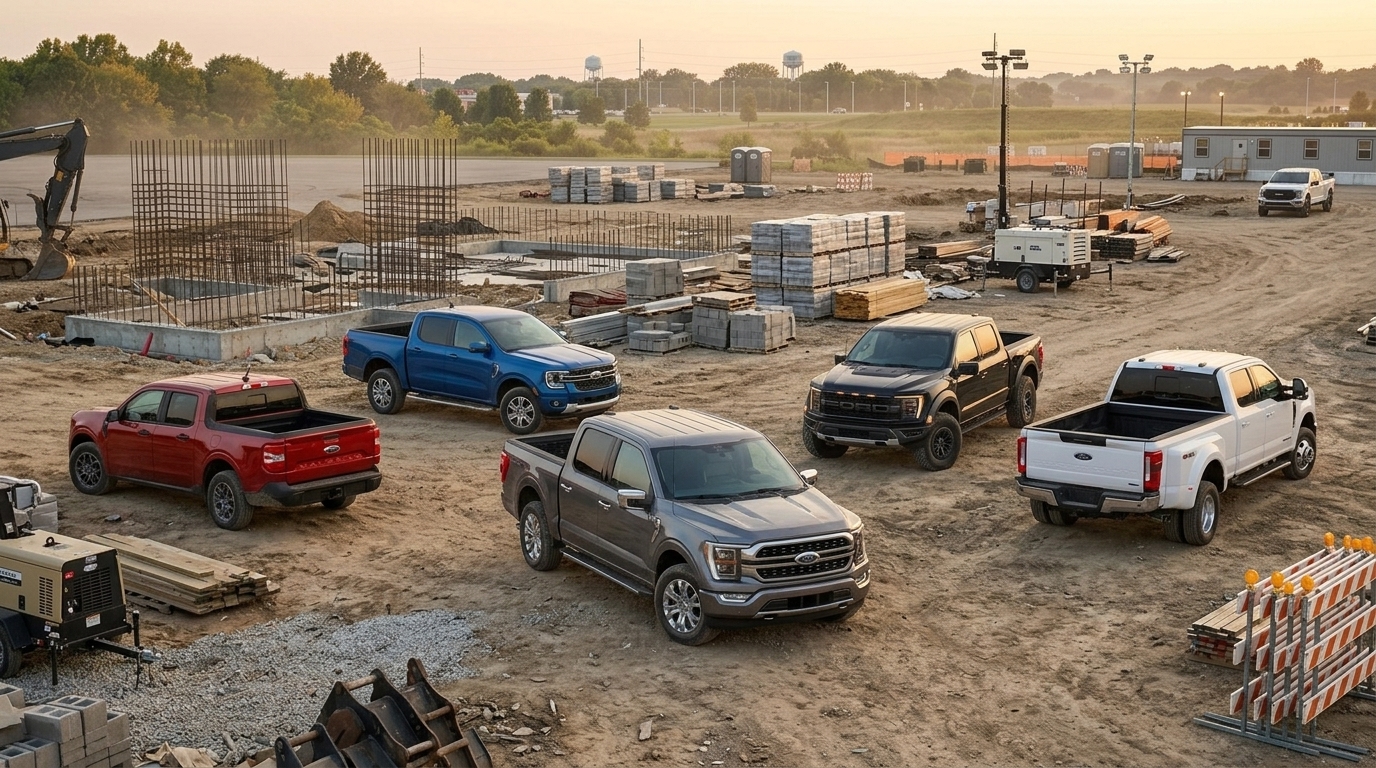
Selecting the right Ford vehicle requires matching your primary daily demands—such as family passenger space, weekly towing, or commuting fuel economy—against your total ownership budget. By comparing platform sizes, powertrain capabilities, and trim features directly, you can determine whether a compact crossover, three-row SUV, or light-duty pickup best fits your everyday driving requirements without overpaying for unnecessary capability.
Navigating the lineup begins with identifying how you intend to use the vehicle on a daily basis. A commuter seeking lower fuel costs and easy parking has very different requirements than a growing family needing three rows of seating or a tradesperson hauling equipment. Vehicles built on unibody frames offer smooth handling and efficient performance, whereas body-on-frame trucks and full-size SUVs deliver rugged durability and heavy trailering strength.
Evaluating power options also helps narrow your search. Ford EcoBoost engine choices balance turbocharged power with practical efficiency, ranging from economical turbocharged three-cylinders to twin-turbo V6 engines built for heavy work. Additionally, driver-assist innovations like Ford Co-Pilot360 technology feature blind-spot monitoring and adaptive cruise control that help keep your family safe on every drive.
Balancing your decision against financial comfort means looking at total ownership costs rather than just the vehicle price. Comparing potential trade-in value, insurance rates, estimated fuel usage, and available financing incentives gives a complete picture of your monthly investment. When you are ready to explore options in person, checking our showroom on South Dupont Highway or giving our team a quick phone call provides direct access to expert guidance tailored to your schedule. For weekend trips toward the coast near Milford with a boat trailer in tow, having the proper powertrain and frame setup makes all the difference in highway confidence.
Table of Contents
- What Towing and Payload Differences Highlight the F-150, Ranger, and Maverick?
- Which Ford SUV Offers the Most Passenger Seating Capacity and Family Utility?
- What Are the Main Differences Between the Ford Explorer and Ford Edge?
- Which Ford SUVs Feature Lower Long-Term Maintenance Costs and Strong Reliability?
- How Should You Compare a New Ford with a Used Ford at the Dealership?
- Common Questions About Ford Model Comparisons Before You Visit the Dealership
- Dependable Performance Meets Modern Technology at Winner Ford
What Towing and Payload Differences Highlight the F-150, Ranger, and Maverick?
Ford truck comparison guides highlight clear capability tiers across the truck lineup: the compact Maverick delivers up to 1,500 lbs payload and 4,000 lbs maximum towing when properly equipped, the midsize Ranger increases towing up to 7,500 lbs, and the full-size F-150 leads with best-in-class maximum towing capacity and rugged durability.
Understanding these structural differences ensures you select a truck that handles your work and recreational needs efficiently:
- Ford Maverick: Built on a maneuverable unibody platform, the compact Maverick uses a standard 2.0L EcoBoost turbo four-cylinder engine generating 250 hp and 280 lb-ft of torque. It is ideal for light home improvement projects, urban parking, and everyday utility.
- Ford Ranger: Featuring a traditional fully boxed steel frame, the midsize Ranger offers impressive midsize muscle. With up to 7,500 lbs towing capacity, it easily pulls midsize campers, utility trailers, and recreational watercraft while maintaining nimble handling on tight roads.
- Ford F-150: As the benchmark full-size truck, the F-150 provides multiple engine configurations, expansive cab setups, and high-tier payload limits. Available features like Pro Power Onboard transform the truck bed into a mobile generator for job sites or campsites.
When truck shoppers walk our lot to compare bed sizes, they usually ask about tailgate height and bed access before looking at maximum tow ratings. Commuters navigating the daily highway drive from Smyrna often lean toward the Maverick for its easy parking and practical utility, whereas tradespeople and heavy towers opt for the uncompromising frame strength of the F-150. Before finalizing your decision, evaluating your current trade-in value can help lower your overall loan balance and make stepping into a higher trim level even more affordable.
Which Ford SUV Offers the Most Passenger Seating Capacity and Family Utility?
The full-size 2026 Ford Expedition delivers the highest passenger seating capacity in the Ford lineup, accommodating up to 8 passengers across three spacious rows with 175 cubic feet of total passenger volume.
For large families and outdoor enthusiasts requiring maximum interior space, the Expedition provides exceptional comfort and capability. Powered by a standard 3.5L EcoBoost twin-turbo V6 engine producing 400 hp and 480 lb-ft of torque paired with a 10-speed automatic transmission, it handles full passenger loads and heavy trailering without strain. Fold-flat second- and third-row seating opens up to 109 cubic feet of maximum cargo space behind the front seats, giving you room for luggage, sports equipment, or camping gear.
By comparison, the midsize 2026 Ford Explorer provides versatile three-row seating for up to 7 passengers. Equipped with a standard 2.3L EcoBoost turbocharged four-cylinder producing 300 hp, the Explorer balances spacious family seating with up to 88 cubic feet of maximum cargo space and standard rear-wheel drive or available four-wheel drive. Advanced safety equipment, wide-opening doors, and accessible third-row step-in make both vehicles reliable choices for family transportation.
Preparing your budget for a full-size or midsize family hauler is simple when working with our finance department. Taking a few minutes to complete prequalifying for financing online allows you to review personalized options built for Dover families before stepping into the showroom.
What Are the Main Differences Between the Ford Explorer and Ford Edge?
The primary differences between the Explorer and Edge center on seating capacity and chassis architecture: the Ford Explorer is a three-row midsize SUV seating up to 7 passengers with rear-wheel-drive or all-wheel-drive options, while the Ford Edge is a two-row midsize crossover seating 5 passengers with standard all-wheel drive.
Under the hood, engine choices reflect their different sizes and performance goals. The Explorer comes standard with a 2.3L EcoBoost four-cylinder making 300 hp, with high-performance trims like the ST featuring a 3.0L EcoBoost twin-turbo V6 that delivers 400 hp. The two-row Edge typically features a standard 2.0L EcoBoost engine or an available 2.7L EcoBoost V6 producing 335 hp.
Utility and cargo metrics also favor the larger Explorer platform:
- Passenger Capacity: Explorer seats up to 7 passengers across three rows; Edge seats 5 passengers across two rows.
- Maximum Cargo Volume: Explorer offers up to 88 cubic feet of cargo space behind row one; Edge provides up to 73 cubic feet.
- Towing Capability: Properly equipped Explorer models tow up to 5,000 lbs; Edge maxes out at 3,500 lbs.
Choosing between them comes down to daily seating priorities and trailering needs. Drivers who prioritize a shorter body for easier garage parking and do not require a third row often prefer a two-row crossover, whereas growing families benefit from the extra seat rows and higher towing limit of the Explorer.
Which Ford SUVs Feature Lower Long-Term Maintenance Costs and Strong Reliability?
Smaller crossover models such as the Ford Escape and Ford Bronco Sport tend to feature lower long-term maintenance costs because of their lighter mechanical components, economical four-cylinder engines, and accessible engine bays.
The compact Ford Escape Active trim utilizes a fuel-efficient 1.5L EcoBoost turbocharged engine producing 181 hp and 199 lb-ft of torque. Its lighter curb weight reduces wear on brake pads, rotors, and tires compared to heavier body-on-frame platforms. Furthermore, common maintenance items—such as oil filters, air filters, and spark plugs—are straightforward to service, which helps keep routine vehicle upkeep predictable and budget-friendly.
The Ford Bronco Sport delivers similar mechanical simplicity while adding standard all-wheel drive and an 8-speed automatic transmission. Lower trim levels powered by the turbocharged 1.5L EcoBoost engine offer strong fuel economy alongside rugged exterior styling.
Every new Ford SUV is backed by standard factory coverage, including a 3-year/36,000-mile bumper-to-bumper limited warranty and a 5-year/60,000-mile powertrain limited warranty. Choosing a vehicle with documented maintenance intervals and standard safety technology supports strong long-term performance and helps preserve resale value over time.
How Should You Compare a New Ford with a Used Ford at the Dealership?
Comparing a new Ford with a pre-owned model requires looking beyond the initial sticker price to evaluate total loan costs, active warranty coverage, available interest rates, and expected near-term maintenance.
A brand-new Ford offers zero prior ownership history, pristine mechanical condition, full factory warranty coverage, and access to the latest driver-assist features. Furthermore, new vehicles frequently qualify for promotional manufacturer financing rates that can lower your monthly interest charges.
On the other hand, choosing a pre-owned vehicle allows you to avoid initial vehicle depreciation and potentially step up to a premium trim level—such as a King Ranch or Platinum—for the price of a mid-level new model. When evaluating a used vehicle, factor in its current tire tread depth, brake wear, and mileage history to account for potential maintenance expenses down the road.
To build an accurate cost comparison:
- Calculate the total financed amount for both vehicles including taxes and fees.
- Compare the loan interest rates and total interest paid over the entire term rather than looking strictly at monthly payments.
- Factor in the value of remaining factory warranty coverage versus purchasing an extended protection plan.
When comparing your choices on the lot, browsing our current new Ford lineup alongside exploring our pre-owned vehicle inventory gives you a clear look at pricing, trim features, and mileage side by side.
Common Questions About Ford Model Comparisons Before You Visit the Dealership
Q: Which Ford truck is best for daily commuting and weekend home projects?
The Ford Maverick is ideal for commuters who need light pickup utility. Its maneuverable unibody design, responsive 2.0L EcoBoost engine, and 1,500 lbs payload rating make it easy to park, efficient on fuel, and fully capable of hauling mulch, lumber, or furniture on weekends.
Q: How much towing capacity do I need for a midsize camper or trailer?
A midsize camper or multi-vehicle utility trailer usually requires a towing capacity between 5,000 lbs and 7,500 lbs. The Ford Ranger ( 7,500 lbs maximum towing) or Ford Explorer ( 5,000 lbs maximum towing) comfortably handle these loads when properly equipped with factory tow packages.
Q: What is the main utility advantage of a full-size SUV over a midsize SUV?
Full-size SUVs like the Ford Expedition feature body-on-frame construction and powerful twin-turbo V6 engines. This setup grants up to 8-passenger seating with adult-friendly third-row legroom, expanded cargo volume up to 109 cubic feet, and significantly higher towing ratings than midsize crossovers.
Q: What driver-assist safety technology comes standard on modern Ford vehicles?
Most modern Ford models include Ford Co-Pilot360 technology as standard or available equipment. This suite features blind-spot monitoring, lane-keeping assistance, pre-collision assist with automatic emergency braking, and adaptive cruise control that helps keep your family safe on daily commutes.
Q: Can buying pre-owned help me afford a higher Ford trim level?
Yes. Choosing a pre-owned model allows you to leverage past depreciation to access upper-tier trims like the King Ranch, Platinum, or ST within a budget that might only cover an entry-level or mid-grade new vehicle.
Dependable Performance Meets Modern Technology at Winner Ford
Finding the perfect vehicle comes down to matching engine power, seating capacity, and towing limits to your daily schedule and family budget. Whether you need the best-in-class towing of an F-150, the 8-passenger room of an Expedition, or the practical efficiency of a Maverick, our local Ford experts are here to walk you through every feature step by step. When you are ready to compare models on a test drive, finding our dealership directions or reaching out at (302) 734-0444 is the easiest way to get started. Schedule your test drive today and see why Dover families trust Winner Ford.
Keep Your Vehicle Running Strong
Keep your vehicle performing at its best with our service team:
Connect with us


- August 2026
- July 2026
- June 2026
- April 2026
- March 2026
- February 2026
- January 2026
- December 2025
- November 2025
- October 2025
- September 2025
- August 2025
- July 2025
- June 2025
- May 2025
- April 2025
- March 2025
- February 2025
- January 2025
- December 2024
- November 2024
- October 2024
- September 2024
- July 2024
- June 2024
- April 2024
- March 2024
- February 2024
- January 2024
- November 2023
- September 2023
- August 2023
- July 2023
- June 2023
- May 2023
- April 2023
- March 2023
- February 2023
- January 2023
- December 2022
- November 2022
- October 2022
- September 2022
- August 2022
- July 2022
- June 2022
- May 2022
- April 2022
- March 2022
- February 2022
- January 2022
- December 2021
- November 2021
- October 2021
- September 2021
- August 2021
- July 2021
- June 2021
- May 2021
- April 2021
- March 2021
- February 2021
- January 2021
- December 2020
- November 2020
- October 2020
- September 2020
- August 2020
- July 2020
- June 2020
- May 2020
- April 2020
- March 2020
- February 2020
- January 2020
- December 2019
- November 2019
- October 2019
- September 2019
- August 2019
- July 2019
- June 2019
- May 2019
- April 2019
- March 2019
- February 2019
- January 2019
- December 2018
- November 2018
- October 2018
- September 2018
- August 2018
- July 2018
- June 2018
- May 2018
- April 2018
- March 2018
- February 2018
- December 2017
- November 2017
- October 2017
- September 2017
- August 2017
- July 2017
- June 2017
- May 2017
- April 2017
- March 2017
- February 2017
- January 2017
- December 2016
- November 2016
- August 2016
- June 2016
- May 2016
Archives
- Automotive News
- Buying Guides
- Certified Pre-Owned Program
- Community Events
- Dover Ford Dealer
- Finance
- Financing & Insurance
- Fleet
- Green
- Maintenance & Service
- Model Comparisons
- New Inventory
- New Vehicle Reviews
- News
- Off-Road & 4WD Features
- Parts
- Parts & Repairs
- Powertrain Care & Repair
- Pre-Owned Inventory
- Pre-Owned Vehicle Sales
- Safety Features
- Seasonal Driving Tips
- Service
- Service Center Tips
- Social
- technology
- Technology & Innovation
- Used Vehicle Guides
- Vehicle Inspection & Certification
- Vehicle Inventory Updates
- Vehicle Ownership & Protection
- Vehicle Trade-In Tips
- Video
- Warranty & Extended Coverage